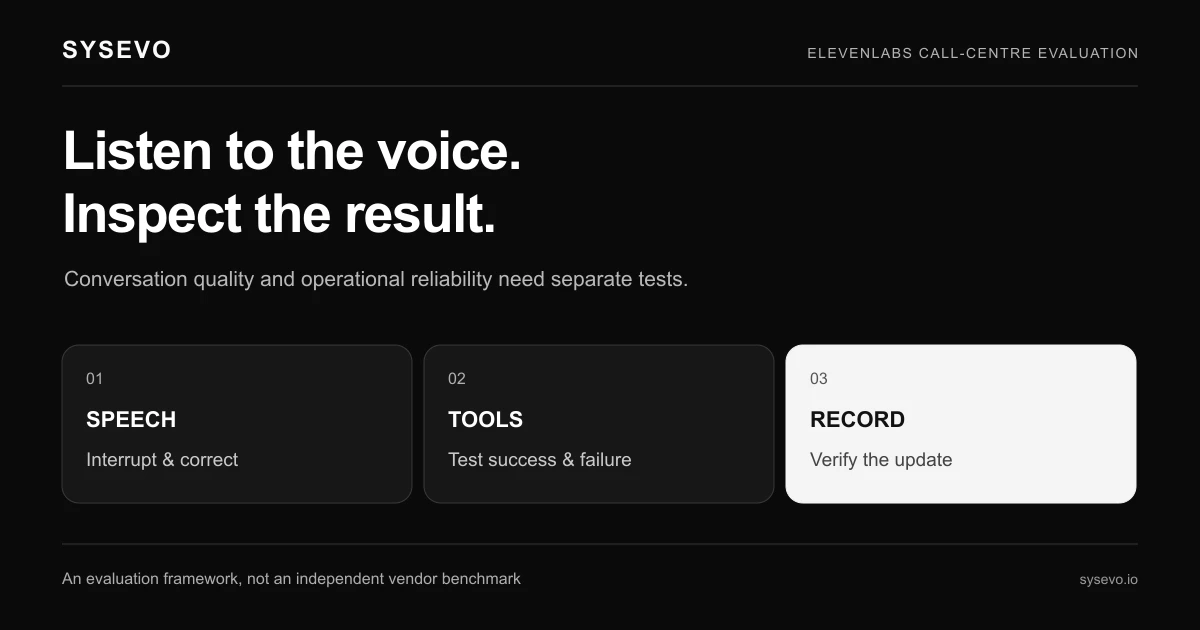

When evaluating Phonely for a call centre, test the full escalation path: how the AI chooses a destination, what context staff receive and what happens when that team cannot answer. A connected transfer is only one part of the outcome.
Independent buyer's guide from Sysevo, a competing provider. We are not affiliated with Phonely. This is not a hands-on product review. Official sources checked on 1 November 2026; confirm current product and contract details directly.
Establish the proposed routing model
The Phonely product site presents AI agents for business communications. Ask the implementation team for the current routing and escalation documentation relevant to your proposed deployment. Confirm the supported path for your phone provider and queues rather than assuming that all implementations behave identically.
Choose a particular queue to evaluate first. Give it a defined caller population, staffed hours, authorised tasks and fallback owner. That makes it possible to judge the result and spot issues that disappear in an aggregate call-volume report.
Build an intent-to-destination map
List the reasons people call and the team that can resolve each one. Separate sales, existing-customer service, billing and requests outside approved scope. Include ambiguous requests and a caller who immediately asks for a person.
Have frontline staff review the map. They know where a technically valid transfer still sends callers to someone without the right authority or information. Record who maintains the rules when team availability, extensions or responsibilities change.
| Test call | Inspect after the interaction |
|---|---|
| Straightforward sales enquiry | Correct queue and useful qualification context |
| Ambiguous request | A clarifying question or agreed central destination |
| Existing-customer issue | Appropriate identity handling and relevant account context |
| Destination busy | Bounded fallback and an assigned next action |
| Caller disconnects | A visible outcome without a falsely completed transfer |
Agree what counts as a completed handoff
Define completion with the receiving team. It might require a person answering, access to the relevant record and enough context to continue the task. A dial attempt or an answered queue announcement may not meet that standard.
Use separate outcome labels for attempted transfers, connections, completed handoffs and callback requests. Ask how the proposed implementation exposes those distinctions. If a vendor report uses a different definition, keep the original definition alongside your own so results remain interpretable.
Test busy periods without disrupting real callers
Arrange controlled tests with designated internal destinations. Include an unavailable agent, a closed queue and a destination that rings without being answered. Confirm the limits and method with the implementation team before simulating volume.
Inspect the callback task after a fallback. It should contain a usable identity, contact route, reason and owner. Have the receiving team try to act on it without asking the builder what happened. This tests the actual operational handoff rather than a screen recording prepared for the demonstration.
Check information boundaries at the transfer
Agree which details can be shared with which queue. Recognising a phone number should not be treated as sufficient identity verification for sensitive account information. Use fictional accounts to inspect access for frontline staff and managers.
Ask how recordings, transcripts and summaries are linked, retained and reviewed for the proposed arrangement. Do not infer a contractual privacy or security commitment from a badge or headline. Obtain the documentation needed for your organisation’s procurement review.
Compare cost per resolved request
Include subscription, usage, telephony, implementation and staff follow-up time. Calculate the cost of correctly completed requests and explain which tasks are included. Some transferred calls will still require significant work from people, which belongs in the operating model.
For another proposal, review Sysevo voice agents, CRM and the platform. Bring the intent map and receiving-agent checklist to a demonstration. Ask for the same normal and failed-handoff scenarios so the evidence can be compared.
Questions buyers ask
What is the difference between a connected and completed transfer?
A call can connect without reaching a person able to continue the task. Define completion with the receiving team and inspect the context they actually receive.
Should an AI call-centre pilot start with every queue?
A defined queue is easier to assess. Establish tasks, hours, staff ownership and acceptance criteria, then expand when the outcome evidence supports it.
What should a fallback record contain?
A usable contact route, the request, the intended destination and a responsible owner, with any time expectation described accurately to the caller.
Related buying guides