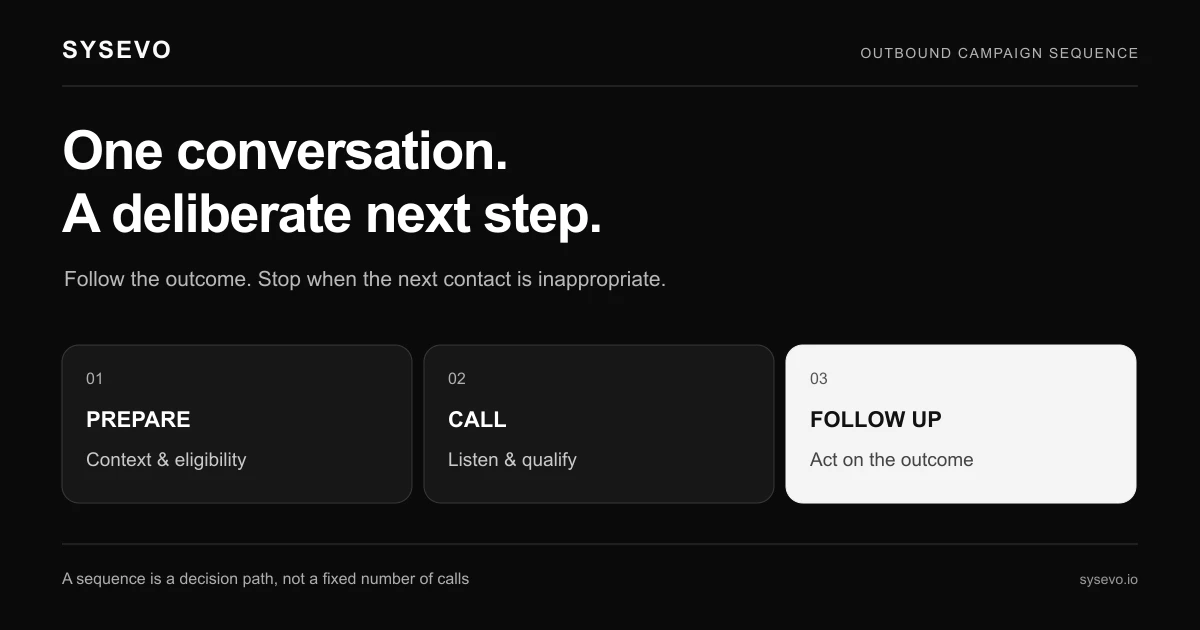

Voice agents outbound sales campaigns represent a fundamental shift in how sales teams scale. Instead of hiring dialers or outsourcing to call centres, you deploy an AI agent that calls prospects on your behalf, qualifies their interest, logs the interaction to your CRM, and books follow-ups without human handoff. The mechanism is straightforward: you load a list of phone numbers, define the call objective and talking points, set the agent loose, and it works through the list at your chosen pace, handling objections, noting decision-makers, and capturing intent in real time.
The appeal is mathematical. A human caller reaches maybe 8 to 12 prospects per day if working a cold list with typical answer rates around 20 percent. A voice agent processes the same list in parallel, reaching far more people, because it doesn't tire and doesn't wait between calls. But raw dial volume isn't the win. The win is data capture and CRM integration. Every call becomes a structured record: prospect name, company, objection raised, next action, deal stage. That foundation makes follow-up systematic instead of chaotic.
How Voice Agents Power Outbound Sales Campaigns
A voice agent outbound campaign works in layers. First, you seed the system with prospect phone numbers and basic context: company name, contact name if you have it, industry vertical. The agent dials from your business phone number or a dedicated campaign number, so recipients see a legitimate caller ID, not a masked line. When someone answers, the agent introduces itself, states the purpose of the call, and begins a scripted conversation adapted on the fly based on the prospect's responses.
The script is not rigid. The agent listens for keywords and sentiment. If a prospect says they're busy, the agent offers to call back at a better time and schedules it. If they raise a specific objection, the agent has trained responses and can pivot. If they show interest, the agent qualifies the opportunity by asking about budget, timeline, and decision-making process, then offers to book a meeting with your sales team. All of this happens in natural English (or other languages), with the agent managing talk time, pauses, and interruptions like a human would.
Critically, the agent writes every interaction to your CRM as it happens. Not after the call, not in batches, but in real time. A prospect says they have a team of 15 people and a Q2 budget? That's logged. They mention their current tool is slow? That's logged. They're uninterested but the decision maker is their CFO? That's logged. Your sales team opens the CRM and finds a warm, qualified hand-off with all context already there. That skip in the handoff cycle is where most sales operations lose deals.
Dial pacing and timing matter too. You can configure the agent to dial continuously, to respect quiet hours (no calls before 9 AM or after 6 PM), to skip Sundays, to space calls on the same list to avoid hammer effects. If you're running a campaign to a small vertical, you don't want three agents calling the same 50 people in one day; the agent respects that and spreads the load intelligently.
The Business Case for Voice Agents in Outbound Sales
The arithmetic of traditional outbound sales is grim. Hiring a dedicated inside sales development rep costs £25,000 to £35,000 per year in salary, plus workspace, phone systems, and training. That person makes roughly 200 to 250 calls per week across a five-day schedule. Over a year, that's 10,000 to 13,000 calls, with a response rate of around 15 to 25 percent, yielding 1,500 to 3,250 conversations. Of those conversations, maybe 10 percent convert to meetings, so you're buying 150 to 325 qualified meetings per year from one hire. At £30,000 salary, that's £92 to £200 per meeting generated before considering ramp time, turnover, and productivity variance.
A voice agent platform costs between £800 and £3,000 per month depending on call volume, feature set, and CRM integration depth. Assume £1,500 per month, or £18,000 per year, and assume the agent runs 500 calls per week (a conservative 4-5 times human volume due to parallel dialing and no fatigue). That's 26,000 calls per year. At a 20 percent response rate, that's 5,200 conversations. Even at a lower conversion rate of 8 percent due to the agent not being a closer, you're generating 416 qualified meetings per year at £43 per meeting. The cost-per-meeting is lower, the consistency is higher, and you still have a human closer managing the relationship.
Real-world operators report that voice agents reduce time-to-contact for leads by 40 to 60 percent. A prospect calls your number or fills a form, and instead of waiting for a human to follow up the next day, they're contacted within an hour. That speed compounds: studies of B2B sales cycles show that contacting a lead within one hour of initial interest increases the probability of a meeting by 7x compared to one-day-later contact. Speed + consistency is a multiplier most teams never achieve manually.
The secondary benefit is data quality. Human teams make notes like "call back next week" or "interested but no budget now." AI agents make structured notes: decision-making timeline is Q3, current tool is Salesforce, team size is 22, pain point is reporting speed. Your sales team has enough context to customize the first email or phone call, which increases close rates. That intelligence flow would normally require a team of people doing pre-call research or lengthy forms; the agent captures it in conversation.
Setting Up Voice Agents Outbound Sales Campaigns from Scratch
Setup begins with list preparation. You need phone numbers. If you have them from a database (ZoomInfo, Apollo, Hunter), you export and deduplicate. You might also add contact names, company names, and any known attributes (company size, industry, job title). The agent doesn't need all of that to work, but having it means the script can personalize: "Hi Sarah, I'm calling because I saw Acme Tech is hiring aggressively in the UK, and we help tech companies onboard teams faster. Do you have 45 seconds?" Personalization lifts answer rates 10 to 15 percent above generic cold calls.
Next, you script the agent. This is not a conversation, it's a set of branches. You write: opening statement, response to "busy now," response to "not interested," response to "tell me more," and so on. A good opening is 15 to 20 seconds: who you are, why you're calling that prospect specifically, what you want (a meeting or a conversation). If they say they're not interested, the agent has a pivot: "I understand. Most prospects we speak to say the same thing until they see how X works. Would you be open to a 15-minute call next Thursday?" These branches are not wild improvisation. They're carefully written, tested, and refined based on call recordings.
The agent needs access to your CRM, or at minimum an integration bridge. Platforms like Sysevo pair voice agents with a built-in CRM, so every call logs instantly. If you use a separate CRM like HubSpot or Salesforce, you need an integration or a webhook so the agent can push call records back. Some platforms offer Zapier integrations as a low-code route. Without CRM sync, you lose the key advantage: your sales team never sees what the agent learned, and your follow-up is blind.
Before the campaign goes live, you run a small pilot. 100 calls, not 1,000. You listen to 10 recordings, review the data logged to your CRM, check that meeting bookings actually appear in the calendar and that prospects received the calendar invite. This quality-gate step catches script issues, integration bugs, or calibration problems before you deploy at scale. Teams that skip this step often find that either the meeting links are wrong, the prospect company field is empty, or the objection handling is too robotic.
Choosing the Right Voice Agent Platform
Not all voice agent platforms are built for outbound campaigns. Some are designed for inbound customer service (routing calls, answering FAQs), and while they can technically make outbound calls, they lack the compliance safeguards, list management, and dial-optimization that sales campaigns require. When you're evaluating platforms, check four things: compliance, integrations, customization, and analytics.
Compliance first. Outbound calling in the UK is regulated by Ofcom rules, which require consent before dialing, clear identification of the caller, respect for do-not-call preferences, and records of consent. A platform marketed for US outbound calling may not handle UK requirements properly, and that exposes you to fines or enforcement action. Ask the vendor directly: "Can this system log and respect UK TPS registrations? Can it handle recorded consent?" A vendor that deflects is a red flag. Serious platforms have compliance teams and will walk you through their approach.
Integration breadth matters. The platform should connect to your CRM in real time, not batch nightly. It should sync campaigns from your existing lead database, not force you to re-enter data. Check: does it work with Salesforce, HubSpot, Pipedrive, or whatever you use? Can it read custom fields? Does it support two-way sync so that when a prospect updates their status in the CRM, the agent knows not to call them? A platform that integrates only with its own CRM is a trap because you're forced to migrate your entire workflow.
Customization determines whether the agent sounds like your brand or a generic robot. Some platforms let you write and test scripts, upload call recordings for training, and tune objection handling. Others offer templated campaigns that all sound the same. For a startup, templated might be fine. For a scaling team, script ownership matters because your tone is part of your brand. Platforms that let you A/B test scripts (variant A: friendly opening, variant B: direct opening) and track which performs better are worth the premium.
Analytics should show you calls made, connects, conversations, outcomes, and conversion rates by source, list, or script variant. Better platforms let you drill into a single call, listen to the recording, see the CRM note, and trace what happened. You need that forensic view to improve the campaign. A platform that says "You made 1,000 calls, 150 people answered" and stops there is hiding problems.
CRM Integration and Real-Time Data Capture
The engine of an effective outbound campaign is CRM integration. Without it, you have a log of calls but no sales system. With it, every interaction feeds the funnel. When the agent calls a prospect and they say "We're evaluating tools in August," that goes straight to a deal record with an August close date and an evaluation deal stage. Your sales team pulls the deal list the next morning and emails the prospect an evaluation guide. That synchrony is rare and powerful.
Real-time logging also prevents duplicate contacts. If Agent A has already called Sarah at Acme on Tuesday and logged the call, Agent B's campaign won't call Sarah again on Thursday. That seems obvious, but many platforms do list-based dialing without real-time CRM awareness, meaning you end up calling the same person twice in the same week, which damages trust and wastes dials. Platforms with live CRM sync avoid that by checking the contact record before dialing.
Some platforms also offer caller memory across campaigns. If Agent A called in January and noted "they said to call back in Q2," and now it's Q2, a new campaign automatically picks that contact and logs a note "follow-up to January outreach." That continuity is invisible to the prospect but valuable to your team because there's no cold restart. The prospect hears "I see we spoke in January about your onboarding challenge..." and the sale feels warmer.
Data standardization matters too. Some platforms force you to map fields: your "Company Size" field becomes their "OrgSize" field becomes your CRM's "OrganizationSizeCategory." Sloppy mapping means the agent captures the right data but it lands in the wrong field and your sales team can't filter by company size. Good platforms handle field mapping transparently so you don't have to think about it. Before you commit, ask the vendor to show you a sample call result and walk you through where every data point lands in your CRM.
Scripting and Objection Handling That Works
The script is the skeleton of the campaign. A bad script makes the agent sound robotic no matter how natural the voice is. A good script guides the agent through branches without sounding pre-recorded. The opening is critical: you have 8 to 12 seconds before a prospect decides to hang up. That opening needs to say who you are, why you're calling that specific prospect, and what you want. Generic opens fail: "Hi, I'm calling about our software." Targeted opens succeed: "Hi Sarah, I'm calling because I saw Acme is building a presence in Europe, and we specialize in helping SaaS teams scale internationally. Do you have 45 seconds?"
Objections are where most agents fall apart. A prospect says "We're not interested" and a bad agent repeats the pitch. A good agent recognizes the objection as a signal and pivots. "I understand. Most prospects we talk to have the same reaction until they see how X works. Would you be open to seeing a 10-minute demo from our team?" Or, if the objection is budget: "I get that. Typically this works because the savings in X pay for itself in 90 days. But I'm not here to convince you today. Would it make sense to grab time next month when you might be thinking about budgets?" These branches show empathy and persistence without aggression.
Successful scripts are built iteratively. You write version 1, run 50 calls, listen to 10 recordings, and identify where the agent struggles or sounds stiff. You rewrite that section. You run version 2. Objections that appear in recordings become new branches in the script. After 5 to 10 iterations, you have a script that converts 25 to 35 percent of connects to conversations, and 10 to 15 percent of conversations to meetings. That's a good baseline. Some campaigns achieve 40 to 50 percent conversation rates by being extremely targeted or high-value, but that requires tight list segmentation and a very specific pitch.
Avoid scripts that sound like a checklist. "So your name is John, you work at Acme, you're in finance, and you've been there five years. Is that right?" That reads like an interrogation. Better: "John, it sounds like you're handling finance operations across the team. How long have you been in that role?" The agent still gathers context but it flows like a conversation. Tools that let you record and listen to agent outputs before the campaign launches help you catch tone issues before they hit real prospects.
Dialing Strategies and List Segmentation
How you dial your list determines campaign velocity and outcome quality. Three strategies exist: blast dialing (dial everyone as fast as possible), staggered dialing (space calls over days or weeks), and segmented dialing (dial high-value segments first, then lower-value). Most B2B outbound campaigns use staggered or segmented to avoid saturation and to learn what works before scaling.
Segmentation works like this: You have 5,000 prospects. You segment by vertical: 500 in software, 500 in finance, 500 in healthcare, et cetera. You dial software first with 100 calls. You get a 25 percent conversation rate and a 12 percent meeting rate. That's decent. You dial finance next with 100 calls. You get 18 percent conversation rate and 6 percent meeting rate. Software is performing better, so you allocate 60 percent of your dialing budget to software for the rest of the month and 40 percent to finance. You pause healthcare for now. This adaptive allocation means you maximize ROI per dial.
Staggered dialing respects the prospect's experience. If you have a list of 500 prospects in the same vertical, you don't call all 500 in the same day. You dial 100 on Monday, 100 on Tuesday, et cetera. Why? Because if all 500 people know each other and all hear from you on the same day, the first call might trigger a Slack message in their group chat, and by the third call, the prospect already knows what you're going to say and hangs up faster. Staggering spreads the word-of-mouth effect over a week, preserving answer rates.
Dial frequency also matters. Some platforms let you set rules like "call each prospect maximum 3 times per campaign" or "wait 3 days between retry attempts." These rules prevent harassment and comply with TPS regulations. A prospect who doesn't answer on day 1 might answer on day 4. A prospect who says "call back next month" should be retried only in next month, not in three days. Platforms that respect these rules show they understand outbound sales; ones that don't are cutting corners.
Measuring Campaign Performance and ROI
Measuring voice agent campaign ROI requires tracking metrics through the entire funnel. At the top: calls attempted, calls connected, answer rate. In the middle: conversations (calls where the prospect engaged for more than 30 seconds), objections raised, outcomes. At the bottom: meetings booked, meetings attended, opportunities created, deals won. Most teams stop at "meetings booked" and miss the real picture: did those meetings convert to customers? That final link is where many campaigns underperform, because the agent can book a meeting but if the script was poor, the prospect shows up skeptical and the sales team struggles to close.
A typical B2B software campaign targeting mid-market will see: 25 to 35 percent answer rate (25 to 35 out of 100 calls reach a human), 40 to 60 percent conversation rate (if they pick up, they stay on the line), 10 to 20 percent outcome rate (of conversations, that many agree to next steps). So 100 dials might yield 25 answers, 15 conversations, and 2 to 3 meetings. That means you're spending campaign costs on ~33 to 50 dials per meeting. At £1,500 per month for a platform that dials 500 calls per week (2,000 per month), that's £0.75 per dial, or £25 to £37 per meeting before sales time. For a £5,000+ deal, that's extremely cost-effective.
Track pipeline velocity too. How long between a meeting and a decision? If the agent books a meeting but the prospect takes 6 months to decide, that meeting is expensive in working capital. If the prospect decides in 30 days, the pipeline turns faster and you fund less inventory. Platforms that show meeting-to-close conversion rates and cycle times help you understand not just volume but quality. A campaign that generates 100 meetings but closes 2 is worse than a campaign that generates 40 meetings and closes 15, even though the volume is higher.
Comparison to manual dialing shows the ROI clearly. If a sales development rep generates 200 meetings per year at a cost of £30,000 plus overhead, that's £150 per meeting. If an agent generates 400 meetings per year at a platform cost of £18,000, that's £45 per meeting. Even accounting for lower quality (fewer close), you're ahead. Real-world teams see 30 to 50 percent improvement in cost per meeting by moving to voice agents.
Compliance, Privacy, and Regulatory Considerations
Outbound calling is heavily regulated. In the UK, the Privacy and Electronic Communications Regulations (PECR) and the Telephone Preference Service (TPS) require that you have prior consent before calling individuals, or that your campaign is to existing customers or prospects who have opted in. Calling TPS-registered numbers without consent incurs fines up to £50,000 per call. Many teams don't check TPS registrations before dialing, and that's a costly mistake. A good platform integrates TPS checks automatically, so every number is flagged against the TPS database before the dial happens.
Consent records matter. If you call someone, you must be able to prove you had consent to call them. That consent can be explicit (they ticked a box) or soft (they filled a form with their phone number). If you can't prove consent, and the prospect complains, you lose. Platforms should give you an audit trail: this prospect gave consent on this date through this channel, and here's the proof. If a vendor doesn't ask about consent tracking, they're not serious about compliance.
Call recording regulations vary by region. In the UK, you should inform the prospect that the call may be recorded, ideally in the opening: "This call may be monitored and recorded for quality purposes." Some regions require two-party consent, meaning both parties must know the call is recorded. Some platforms handle this automatically, inserting a recorded disclaimer at the start of every call. Others leave it to you. Make sure your chosen platform handles regional differences correctly, because non-compliance can result in calls being inadmissible in disputes or subject to legal challenge.
GDPR and data protection apply too. Every prospect's phone number and any data you capture during the call is personal data under GDPR. You must have a privacy notice, a lawful basis for processing that data, and procedures to delete data if requested. A platform that doesn't discuss data protection or retention policies is a red flag. Ask: where are calls recorded and stored? How long are they kept? Can prospects request deletion? A compliant platform should answer all of these clearly and let you download a DPIA (Data Protection Impact Assessment) template for your records.
Common Pitfalls and What Goes Wrong
Pitfall one: launching without a pilot. Teams load 10,000 numbers, set the agent loose, and within 48 hours realize the script is terrible, the CRM integration is broken, or the agent is calling people who already bought from you. Always start with 50 to 100 calls, listen to the recordings, check the CRM records, verify meeting bookings work, and fix issues before scaling. A 48-hour pilot saves weeks of cleanup.
Pitfall two: poor list quality. Garbage in, garbage out. If your phone number list is 40 percent invalid, 20 percent deceased people or old employees, and 10 percent already customers, your answer rate will be 5 to 10 percent instead of 25 percent. Your cost per meeting triples. Validate lists before uploading: remove duplicates, cross-check against your customer database, use a data validation service like DataBox or Apollo to verify company sizes and job titles. A 20 percent investment in list cleaning pays for itself in wasted dials avoided.
Pitfall three: setting and forgetting. Teams deploy a campaign and assume it will work. It won't, at least not on day 1. The agent might be getting script interpretation wrong, or the dial rate might be too fast and answer rates are dropping, or the CRM fields aren't mapping correctly. You need daily monitoring for the first week: call volume, answer rate, conversation rate, meeting rate. If answer rate drops from 30 percent to 15 percent after 200 calls, something changed (caller ID reputation degraded, list quality dropped, time of day shifted). Find and fix it immediately instead of wasting 500 more dials.
Pitfall four: hiring the agent instead of managing it. An agent is a tool, not a replacement for sales strategy. If your sales team can't close deals from inbound leads, they won't close deals from agent-generated leads. If your sales messaging is confused, the agent will confuse prospects. If you have no follow-up process, meetings will be missed. The agent amplifies existing systems. If your system is broken, the agent makes it worse faster. Before you deploy, fix your sales process. Then use the agent to fuel it at scale.
When Voice Agents Don't Fit Your Sales Model
Voice agents work best for high-volume, lower-touch, B2B campaigns targeting decision-makers at scale. They're less suitable for three scenarios, and it's important to be honest about fit. First: if your deal size is below £1,000, your unit economics probably don't work. You spend £50 to £100 to generate a meeting, and if your deal is £500, you need a 20 percent close rate just to break even. That's possible but tight. Second: if you sell to consumers or require relationship building before the pitch, an agent's cold approach won't work. A prospect considering a £50,000 coaching program doesn't want to be called by an AI; they want a consultant who can understand their business. Third: if your list is tiny (fewer than 500 prospects), you're better off hiring a part-time sales contractor. The fixed costs of platform setup and configuration aren't worth the volume.
Also, if your sales cycle is extremely long (12+ months) and deal size is very high (£100,000+), an agent might reach the right person but they won't close. They'll qualify. The agent's job is to identify interested prospects and hand them to your sales team; it's not to close £100,000 deals. Make sure your team understands that boundary. Some leaders expect an agent to do everything, and when it doesn't close deals alone, they consider it a failure. That's misunderstanding the role.
Lastly, if you have a small list of highly specific, high-value accounts (account-based marketing), a voice agent is overkill. You'd be better off with a targeted email sequence and a manual call from a senior salesperson. ABM works on customization and personalization at depth, not automation at scale. An agent is the opposite: it trades depth for breadth.
Building a Custom Voice Agent Outbound Strategy
A sustainable outbound strategy has three layers: prospecting, nurturing, and closing. Voice agents handle the prospecting layer: finding prospects who fit your ICP, qualifying their intent, and handing off warm introductions. Email and content handle nurturing: staying in front of prospects who aren't ready now but might be in Q3. Your sales team handles closing: moving deals across the finish line. Each layer needs clarity about what it owns and how it hands off to the next layer.
Your prospecting strategy should define: who is your ICP (company size, industry, revenue, pain point)? Where do you find them (database, list broker, inbound)? How many dials per day can you handle (limited by your sales team's bandwidth to follow up)? What's your script's core message? What counts as a successful outcome? If you dial without answering these, you'll have unfocused campaigns that generate meetings your team can't handle.
Segmentation within prospecting also matters. You might have three campaigns running: campaign A targets software companies with 50-500 employees (your sweet spot), campaign B targets software companies with 500-5000 employees (higher deal size but longer sales cycle), and campaign C targets marketing leaders within those companies (different persona, different pain points). Each campaign has its own script, list, and success metrics. Running three focused campaigns outperforms one mega-campaign.
Integration with your sales team's calendar and CRM is non-negotiable. The agent books a meeting; the sales person opens the CRM and sees all the intelligence already captured. The sales person updates the opportunity status; the agent sees it and doesn't retry that prospect. Outbound campaigns that lack this two-way sync create friction and duplicate work. Pick a platform that makes integration seamless, or plan to hire a technical integration person to build the bridges yourself.
Scaling from Pilot to Production
Once your pilot succeeds (say, 100 dials at a 12 percent meeting rate is your baseline), scaling means increasing volume responsibly. Double your dial rate to 200 dials per week. Monitor for one week. If metrics hold (12 percent conversion), increase to 400. If metrics drop (to 8 percent), investigate before scaling further. Scaling too fast damages your caller ID reputation (carriers mark your number as spam), burns through lists, and overwhelms your sales team's follow-up capacity.
Your sales team's follow-up capacity is the bottleneck. If you generate 50 meetings per week but your team can follow up on only 30, the other 20 go cold and your conversion rate craters. Before you scale agent output, you must have sales capacity. That might mean hiring another closer, or it might mean tightening your qualification so the agent only books meetings for the top 20 percent of prospects instead of the top 30 percent. Know your team's limit and respect it.
As you scale, also monitor list fatigue. If you keep dialing the same list, answer rates will drop over time because prospects get sick of hearing from you. Introduce new lists quarterly. If you run a campaign in Q1 and Q2 on the same 2,000 prospects, by Q2 your answer rate might drop 5 to 10 points because people remember your previous call. Fresh lists keep the machine running at steady-state ROI.
Consider white-label or reseller partnerships if you're operating at massive scale. If you're making 50,000+ calls per month, vendor support becomes important, and dedicated account management makes a difference. Platforms that offer partner programme terms give you better pricing, faster issue resolution, and sometimes co-marketing support. Negotiate based on volume.
Voice Agent Tools and Platform Features to Evaluate
When comparing platforms, look for: natural voice quality (does the agent sound robotic or human?), conversation intelligence (can it handle interruptions, accents, background noise?), script flexibility (how easy is it to write and test new objection branches?), integration breadth (does it connect to your existing tools?), compliance tooling (TPS checks, consent tracking, call recording disclosures), analytics depth (can you drill into individual calls and understand what happened?), and support quality (does the vendor respond in hours or days when something breaks?).
Voice quality has improved dramatically in the past two years. Older platforms sounded distinctly AI, making prospects more defensive. Modern platforms use large language models trained on thousands of hours of natural human conversations, and the gap is narrowing. Some platforms let you customize the agent's tone: casual and friendly, or direct and professional. Test the agent's voice yourself before committing. If it sounds off, prospects will feel it too.
Conversation intelligence (the agent's ability to understand and respond naturally) determines whether campaigns succeed. A basic agent might say, "You sound busy, I'll call back later" if the prospect mentions being in a meeting. A smarter agent might say, "I know you're in the middle of something. Quick question: are you the right person to discuss our platform, or should I reach out to your CTO?" The latter shows intelligence and gets a more useful answer. Test agents on messy inputs: what happens if the prospect interrupts? If there's background noise? If they say "Who is this?" before you finish the introduction?
Customization goes beyond scripts. Some platforms let you set campaign-specific rules: this campaign should sound friendly and casual, this one should sound executive and direct. Some let you upload your company's tone guide or brand guidelines. Some don't. If your brand's voice matters to you, pick a platform that lets you shape it, not one that forces you to sound generic.
Making the Business Case to Stakeholders
Selling voice agents to your leadership requires numbers they care about: cost per lead, cost per meeting, cost per qualified opportunity. Take your current state (a sales development team generating 200 meetings per year at £30,000 salary) and compare to the agent scenario (generating 400 meetings per year at £18,000 platform cost). That's a 2x improvement in cost per meeting. But don't oversell it. Add caveats: "These numbers assume the agent is well-scripted, the list is clean, and our sales team has follow-up capacity." Leaders who understand the conditions are more likely to fund a pilot.
Build the case around time, not just cost. Dialing 2,000 calls per month manually takes a full-time person. That person could instead be closing deals, or handling strategic accounts, or building relationships. The agent frees up human time for higher-value work. That's a productivity story, not just a cost story. Productivity stories resonate with operations leaders because they see the ripple effects: faster sales cycles, higher close rates, more revenue per headcount.
Start with a small budget request. "Let's try a £5,000 pilot: three months on a platform that fits our tech stack, 500 calls per month, and see if we can generate 5 to 10 qualified meetings. If it works, we scale. If not, we stop." That's a low-risk frame. Leaders understand pilots. They'll approve a pilot where they might reject a £50,000 annual commitment.
Be explicit about risks too. "The main risk is that the agent sounds robotic or the script doesn't resonate, in which case we generate few meetings and the campaign fails. We'll mitigate that by testing on a small list first and iterating the script before scaling." Vulnerability and risk management increase credibility. A pitch that sounds too good to be true raises skepticism; a pitch that acknowledges risks and has mitigations sounds like a real plan.
Integration with Your Existing Sales Stack
Your sales tech stack probably includes a CRM, an email platform, a calendar, maybe a proposal tool or a dialer. The voice agent needs to integrate with the CRM at minimum, and ideally with the calendar so meetings booked by the agent appear automatically. Some platforms use pre-built integrations (to HubSpot, Salesforce, Pipedrive). Others use webhooks or Zapier so you can bolt them together yourself. Check integration availability before committing, because if the platform doesn't sync with your CRM, you're doing manual data entry and defeating the purpose.
Email platforms are secondary but useful. If the agent books a meeting, it's nice if the agent can also send a calendar invite and a pre-meeting email to the prospect, all from your email domain. Some platforms handle that natively. Others require your email platform to send the follow-up, which means one more tool learning about the interaction. The fewer hand-offs, the better.
Calendar synchronization prevents double-booking. If your sales person is already booked at 2 PM on Tuesday, the agent shouldn't offer that slot. If your platform integrates with your team's calendar, it sees the conflict and suggests the next available time. That looks professional and avoids the awkward "actually I'm not available then" email back-and-forth.
If you have multiple sales regions or teams, consider a platform that supports team-level permissions and visibility. Team A should see only their prospects and meetings, not Team B's. A platform that offers role-based access control (admin, manager, user) is more suitable for growing teams than one that's all-or-nothing.
Training Your Team to Work with Voice Agents
Deploying an agent and expecting your team to use it without training is a common failure mode. Your sales team needs to understand: what does the agent do and not do? (It qualifies, it doesn't close.) What data is reliable? (If the agent captured a budget, it's usually trustworthy; if the agent says "not interested," that might be a stalling tactic, not a real objection.) How do I follow up? (Call within 24 hours, reference what the agent learned, confirm it's still relevant.) What happens if the prospect says "I didn't authorize that call"? (Apologize, confirm consent, log it, and don't call again.)
Create a simple playbook. "When you see a meeting booked by the agent, first thing: read the agent's notes. If it says 'budget in Q3, evaluate in August,' your first call should assume that's real. If it says 'not interested now,' plan a follow-up in 6 weeks, not tomorrow." Playbooks prevent your team from treating agent-qualified leads the same as other leads, which dilutes the agent's value.
Set up feedback loops. Have your sales team flag agent script issues (e.g., "the agent says we do X but we don't") and update the script monthly based on their feedback. Have them note conversation patterns: "Every prospect asks about pricing. Should the agent have an answer ready?" That iterative improvement is how you move from a 8 percent conversation rate to 12 percent.
Also, make it clear that working with an agent is different from hiring a sales contractor. The agent is a tool that your team manages, not a person who owns accounts. If your team tries to treat the agent like a remote salesperson, it will be disappointed. If your team uses it as a prospecting engine that feeds the funnel, it will succeed.
Future Trends and What's Coming Next
Voice agents are becoming more sophisticated. Newer platforms add: emotion detection (the agent senses hesitation in the prospect's voice and softens the pitch), real-time coaching (the agent suggests what to say next mid-call if it detects confusion), and intent prediction (the agent infers whether the prospect will close even before they say so, adjusting the call strategy on the fly). These features are still emerging but within 12 to 24 months they'll be table-stakes.
Integration with other AI systems is also coming. Imagine: the agent calls, qualifies the prospect, and if the prospect is high-value, the system automatically triggers a follow-up email from your CEO, or a custom demo link, or a special offer. Or, if the prospect is low-fit, the agent re-qualifies them for a different product line. That kind of AI-to-AI coordination is in development at most major platforms.
Privacy regulations will tighten. The GDPR is already strict; California's CCPA is following. Expect more regional rules on AI calling. Platforms that invest in compliance infrastructure now will have an advantage as regulations evolve. Vendors that dodge compliance questions now will be in trouble in two years.
Lastly, voice agents will likely shift from "outbound calling" to "multi-channel outbound." Instead of just calling, the same agent might send an SMS if the call isn't answered, then send an email if the SMS isn't replied to, then post on LinkedIn. That omnichannel approach lets you reach more prospects, more persistently, without coming across as a stalker. Expect platforms to consolidate calling, SMS, email, and chat into one unified agent in the next 12 to 18 months.
Frequently Asked Questions
Do voice agents sound like robots, and will prospects be put off?
Modern voice agents sound mostly human, but the quality varies by platform. The gap closes monthly as AI improves. Most prospects don't realize they're talking to an AI until the agent says so. However, if your script is stiff or the agent mishandles an unexpected input, it becomes obvious. Test the agent's voice yourself and listen to sample calls before committing. If it sounds off, prospects will sense it.
How long does it take to set up a voice agent campaign?
A basic campaign takes 1 to 2 weeks from contract signature to first calls. You need to: set up the account (1 day), prepare your list (2-3 days), write and test the script (3-4 days), configure CRM integration (2-3 days), run a 50-call pilot and iterate (3-4 days), then go live. If you have existing integrations and a clear script, you could do it in 5 days. If you're starting from scratch, allow 2 weeks.
What's the minimum list size to make voice agents worthwhile?
Ideally 500+ prospects, but you can test with 100. Below 500, the economies of scale get tight because platform setup, scripting, and iteration cost the same whether you call 200 or 2,000 people. If your prospect universe is really small, you might be better off with manual outreach or a telemarketing service.
Can voice agents handle objections and negotiate?
They can handle scripted objections to a point. If the prospect says "We don't have budget," the agent can offer a follow-up. But if the objection is nuanced ("We have budget but we're evaluating three platforms,") the agent might struggle to navigate. Agents are best for qualification and interest-building; negotiations and complex closes should be handed to humans.
How much does a voice agent platform cost, and how do I calculate ROI?
Costs range from £500 to £3,000+ per month depending on call volume. A typical platform starts at £1,500 per month and covers 2,000 to 5,000 calls. ROI is usually positive within 3 to 6 months if you're replacing a sales development hire (£30,000+ per year in salary), but varies wildly based on deal size, close rate, and list quality. Calculate: (platform cost per month) / (meetings generated per month) × (close rate) × (deal size) to see if it pencils out.
Is it legal to call people with a voice agent, and do I need their permission?
In the UK, you need either explicit consent (they ticked a box) or a soft opt-in (they filled a form with their phone number as a business contact). Calling TPS-registered numbers without consent is illegal and carries fines. A compliant platform will check TPS registrations automatically and require you to confirm consent. Always read your platform's compliance documentation and consider consulting a lawyer familiar with PECR.
Can I use a voice agent for follow-up calls to existing customers or prospects?
Yes, and it often works better. Existing customers have already shown interest, so answer rates are higher and conversation rates are better. Many campaigns use agents for initial outreach and then transition to human reps for follow-up. Some teams use agents to call customers who have gone quiet, with a script like "Hey, we haven't heard from you in six months. Just checking in to see if anything has changed." That works well because the intent is clear and low-pressure.