Zanusai.com is a platform primarily focused on content creation and AI writing tools, not customer communication infrastructure. To answer directly: no, Zanusai.com does not offer AI receptionist services or phone-based AI agents. If you are searching for whether Zanusai.com provides an AI receptionist solution, you are looking at the wrong platform. This matters because choosing the right tool saves weeks of implementation time and prevents the frustration of discovering a platform cannot do what you need after you have already invested in learning it.

The confusion often arises because "AI" encompasses many different product categories. Zanusai.com operates in generative writing and content automation. An AI receptionist, by contrast, operates in real-time voice communication, call routing, CRM data capture, and appointment scheduling. These are fundamentally different technical stacks, and a platform strong in one rarely competes in the other. Understanding this distinction is the first step toward finding the right solution for your business.

What Zanusai.com Actually Does

Zanusai.com is built around artificial intelligence for content generation. The platform helps users create written materials, from blog posts to marketing copy, using language models. Teams use it to automate repetitive writing tasks and scale content production without hiring additional copywriters. For marketing departments managing multiple channels or freelancers producing long-form content, this solves a real problem: the time cost of writing at scale.

The platform operates in the pre-sales and marketing funnel rather than customer service operations. A marketing manager might use Zanusai to draft email campaigns or product descriptions; they would not use it to answer phones or route customer calls. The underlying infrastructure is cloud-based text generation, not telephony integration or voice processing. This is a meaningful limitation if you expected to find phone-handling capabilities there.

Zanusai.com does not integrate with phone systems, PBX infrastructure, or telephony APIs. It has no voice recognition or speech-to-text engines tuned for live call handling. It does not capture caller information, write to CRM systems based on inbound calls, or schedule appointments from phone conversations. These gaps are not oversights; they reflect the product's intentional scope. A platform cannot be excellent at everything, and Zanusai has chosen to focus on text generation rather than voice operations.

What An AI Receptionist Actually Does

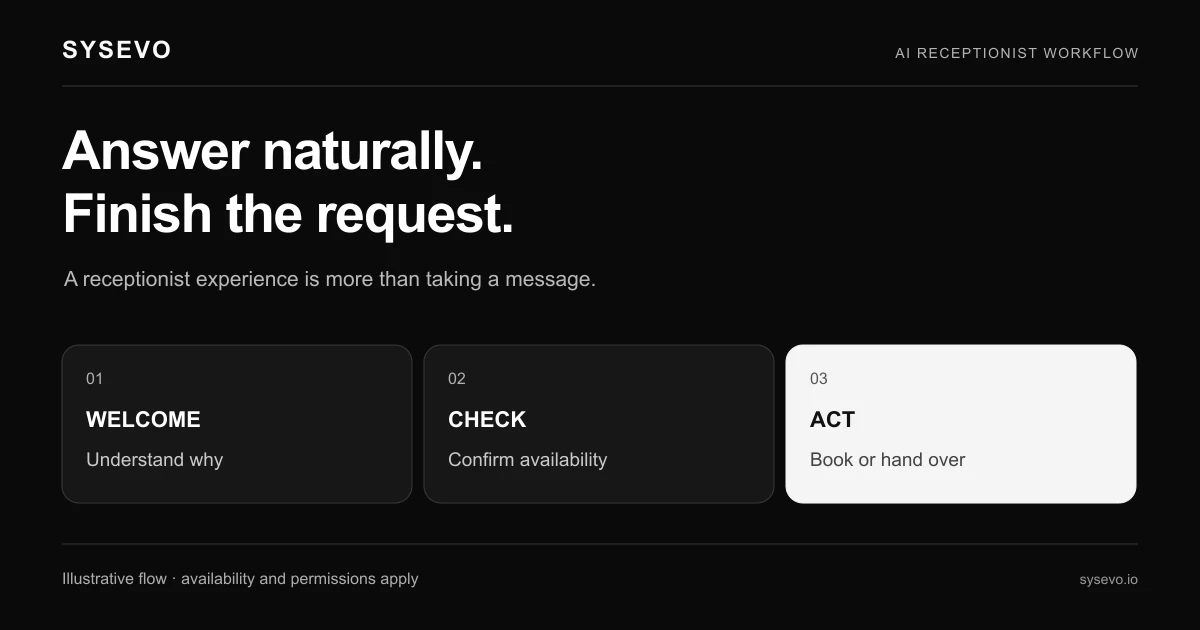
An AI phone agent or virtual receptionist AI performs a different set of tasks entirely. When a call arrives, the AI system answers within two rings, listens to the caller's request in real time, transcribes the conversation, and decides what action to take. It might book an appointment, gather information for a callback, route the call to a human team member, or handle routine inquiries without human involvement at all. These decisions happen in seconds, while the caller stays on the line.

Integration with a built-in CRM is the backbone of this workflow. The AI doesn't just capture the call; it writes a summary to your existing contact record, updates the appointment calendar, and flags urgent callbacks. If a customer calls back the next day, the AI can say, "I see you called yesterday about your invoice issue. Let me pull that up for you." This requires persistent caller memory and real-time database writes, neither of which Zanusai.com provides.

An AI receptionist typically handles between 30 and 70 percent of all incoming calls without escalating to a human, depending on call complexity and industry. A dental practice might see the AI book 80 percent of routine appointment calls. A financial services firm might see the AI gather initial information and transfer 40 percent of calls to a specialist. The remaining calls require a human agent, but the AI has already documented everything, saving the agent time and reducing repeat questions.

Does Zanusai.com Offer AI Receptionist Through Partnerships

Zanusai.com does not market any partnerships or integrations with phone system providers or AI voice agent platforms. Their focus remains on written content generation, and there is no public information suggesting they have expanded into telephony services. They do not list phone-handling capabilities on their website, in their feature documentation, or in their product announcements. If such a service existed, it would be featured prominently, because it would represent a major product expansion.

It is possible that a Zanusai.com user might combine their platform with a separate AI phone system for a complete workflow. For example, a user could use Zanusai to draft customer follow-up emails after calls are completed by a different platform. But this is not integration; it is simply using two tools in sequence. The systems do not talk to each other, and Zanusai plays no role in the actual phone handling. This distinction matters because it means Zanusai cannot manage call routing, capture caller intent, or integrate phone data into your CRM.

When evaluating whether a platform offers a specific feature, check their pricing page, feature matrix, and API documentation. If a capability is not listed in any of those places, and there are no case studies showing it in use, it is not part of the product. Zanusai.com passes none of these tests for AI receptionist functionality. The platform is transparent about what it does: content generation. Do not expect it to do what it does not claim.

Where To Find An Actual AI Receptionist Solution

Platforms built specifically for AI voice agents handle incoming and outbound calls, capture caller details, and integrate directly with CRM systems. These platforms maintain persistent caller profiles, allowing the AI to recognise returning customers and reference previous conversations. They support multiple communication channels: inbound calls, outbound campaigns, and often SMS or chat. The infrastructure includes telephony APIs, voice processing engines, and database connectors that Zanusai.com never needed to build.

When evaluating an AI receptionist platform, look for evidence of real-time call handling. Can the system answer a call within two rings? Can it transcribe the conversation accurately? Does it write call summaries to your CRM automatically, or do you have to export data manually? Can it transfer calls to a specific team member based on call routing rules? Does it integrate with your existing phone system, or does it require you to change your phone number? These are not academic questions; they determine whether the platform will actually reduce your missed calls and save your team time.

Industry benchmarks put the cost of an AI receptionist system between £50 and £300 per month for small to mid-sized businesses, depending on call volume and feature depth. The main variables are the number of inbound calls per month, whether you need outbound campaign capability, and how deeply the system integrates with your CRM. A dental practice taking 200 calls per month might pay £80 monthly. A law firm handling 2,000 calls and requiring detailed call logging might pay £250. Zanusai.com, as a content platform, operates on a completely different pricing model and cost structure.

When An AI Receptionist Is The Right Choice

An AI phone agent becomes valuable when your team is missing calls or spending time on repetitive phone tasks. If you run a service business like plumbing, hairstyling, consulting, or medical practice, an AI receptionist can answer appointment requests 24 hours a day, check availability, and confirm the booking in your calendar. Your staff arrives to work with a full day of pre-confirmed appointments and no missed leads. The AI handles the volume spike when everyone calls at 9 a.m., something a human receptionist alone cannot manage.

For businesses running outbound campaigns, an AI phone agent can call prospects to set meetings, qualify leads, or conduct surveys. The outbound campaigns feature handles thousands of calls per week, far more than a human team. Operators report that AI-driven outbound calling reaches 4 to 5 times as many prospects per week as manual calling, because the AI never tires, never forgets to dial, and doesn't need breaks. For companies with high call volume, this is not a luxury; it is a scaling problem.

Industries that see the fastest ROI from AI receptionists are those with high call frequency and simple call types. Appointment-based businesses (medical, dental, beauty, fitness), property management, automotive repair, and hospitality all benefit immediately. A restaurant using an AI receptionist to handle reservation requests can increase bookings by 15 to 30 percent simply by answering every call. Industries with more complex inquiries, like insurance or enterprise software, typically use the AI to qualify and transfer calls, not resolve them entirely.

When An AI Receptionist Is The Wrong Choice

An AI receptionist is not the right tool if your calls are highly technical or emotionally sensitive. If you run a mental health counselling service, callers need to speak to a trained human, and handing them off to an AI first creates immediate frustration. Insurance claims inquiries, legal matters, and complex product debugging often require specialist judgment on the first call. An AI that misunderstands the situation or uses the wrong tone can damage the relationship rather than strengthen it. In these cases, an AI receptionist creates extra work instead of savings.

Cost is also a trade-off. If your business takes fewer than 100 calls per month, the monthly platform fee rarely justifies the implementation work and training time. A solo consultant or micro-agency might handle calls manually faster than they could configure an AI system. The platform fee is fixed; the call volume must be high enough to amortise that cost. Additionally, some older phone systems or VOIP providers do not support the integration points that modern AI receptionists require, creating technical obstacles that can take weeks to resolve.

Performance also depends on call clarity and script predictability. An AI receptionist trained on English may struggle with heavy accents, background noise, or unusual accents in the data. If your customer base includes many non-native speakers or calls regularly happen in noisy environments, the transcription accuracy drops, and the AI makes more mistakes. For businesses with highly variable call flows, where every conversation is unique, rule-based AI systems can struggle to stay on topic and may escalate unnecessarily. These are not failings of the technology; they are honest limits on what pattern matching can achieve today.

Comparing Your Options Properly

Start by mapping your actual call handling. How many calls arrive per week? What percentage of those are appointment requests, routine inquiries, or information gathering versus complex problem-solving? How many calls does your team miss or let go to voicemail? What does a missed call cost you in lost revenue or customer frustration? If you are missing 20 calls per week and each one represents a £200 sale, you are losing £4,000 per week to call handling capacity. A platform costing £150 per month becomes an obvious investment when the math is this clear.

Next, audit your CRM integration requirements. Does the system need to write to Salesforce, HubSpot, or a custom database? Does it need to pull existing customer records so the AI recognises returning callers? Should it trigger automated follow-up emails after calls? Can your phone system handle the technical handoff? These questions determine which platforms are even viable for your business. Do not assume all AI receptionist platforms are compatible with all phone systems; some require you to change your phone number or replace your existing PBX.

Finally, run a trial with real call volume before committing long-term. Most platforms offer a 7 to 14 day test period. Have the AI handle a subset of your calls, and track how many it resolves without human escalation. Measure the quality of the data it writes to your CRM. Time how long it takes a human agent to handle a transferred call versus a warm handoff. This direct evidence is worth far more than any feature checklist. Once you have real numbers, you can calculate ROI and decide if the platform deserves a longer contract.

Frequently Asked Questions

Is Zanusai.com a phone system or communications platform?

No. Zanusai.com is a content creation and writing automation platform. It does not offer phone services, voice handling, or communications features. It is designed for generating written content like blog posts and copy, not managing incoming or outgoing calls.

Can I use Zanusai.com to automate my business phone lines?

No. Zanusai.com has no integration with phone systems, VOIP providers, or PBX infrastructure. It cannot answer calls, route them, or capture caller information. For phone automation, you need a platform specifically built for voice communication and call handling.

Does Zanusai.com integrate with CRM systems like Salesforce or HubSpot?

Zanusai.com may have some CRM integrations for workflow purposes, but these relate to content management, not call handling. An AI phone agent system, by contrast, uses CRM integration to log call details, store caller profiles, and update appointment records in real time during conversations.

What is the difference between content generation AI and a phone receptionist AI?

Content generation AI (like Zanusai.com) processes text and generates written outputs. A phone receptionist AI listens to live speech, transcribes it, understands intent, and executes actions like booking appointments or transferring calls. They require completely different underlying technology and infrastructure.

Where should I look if I actually need an AI receptionist for my business?

Look for platforms specifically marketed as AI phone agents, virtual receptionists, or voice AI systems. These platforms handle inbound and often outbound calls, integrate with CRM systems, and offer features like caller memory and appointment scheduling. You can book a call to discuss your specific needs and find the right fit for your business.