
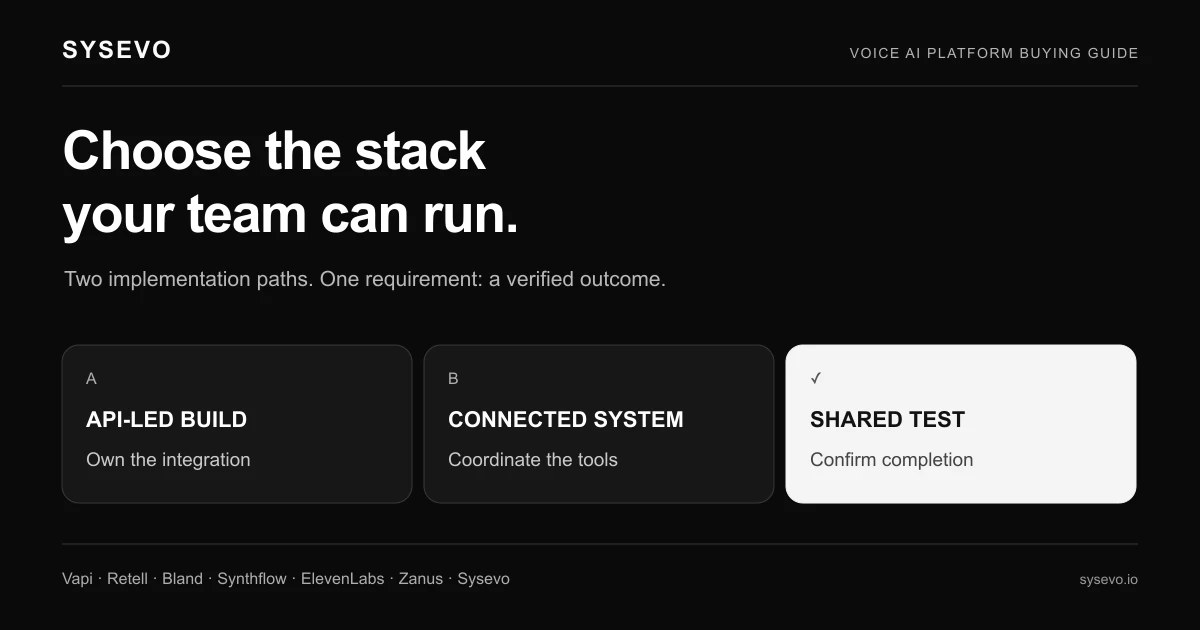
The right API voice AI platform depends on what your team wants to build and operate. Compare Vapi, Retell AI, Bland AI, Synthflow, ElevenLabs, Zanus and Sysevo by the workflow you need to deliver, rather than a generic “best platform” ranking. All seven are relevant to voice automation, but the documented offerings and operating models differ.
Editorial review: 4 October 2026. Written by Sysevo, a vendor in this market. Vendor capabilities below are documented claims, not results from an independent deployment test. Examples are illustrative.
API-led build or connected business system?
An API-led approach makes sense when you want to control application logic and connect an existing stack. You must decide who owns credentials, retries, customer matching, monitoring and the final business update. A connected platform can reduce the number of separate tools you operate, but you still need to understand its permissions, integrations and limits.
Neither approach removes the need for testing. A tool call can succeed technically while updating the wrong record. A natural conversation can still leave an appointment unconfirmed. Start with the business outcome, then choose where each part of that workflow will live.
Seven providers worth evaluating
| Provider | Relevant documented offering | Your next evaluation question |
|---|---|---|
| Vapi | Outbound campaigns documentation describes call lists, assistants or squads, and concurrency controls. | Who owns the CRM update, retry rules and post-call workflow in your implementation? |
| Retell AI | Automated calling documentation describes inbound and outbound agents and batch calling. | Can the deployed agent finish your specific task and handle failed integrations? |
| Bland AI | Its official site presents an enterprise voice AI platform for phone agents. | What implementation support, operating responsibility and contract fit do you need? |
| Synthflow | Agent setup documentation distinguishes inbound, outbound and chat agent types. | How will the configured agent use your systems and pass exceptions to staff? |
| ElevenLabs | Its Agents platform describes conversational agents with knowledge, workflows, tools and analytics. | Which tools, channels and operational controls does your proposed deployment include? |
| Zanus AI | Front Office presents an integrated system including AI Phone and business tools. | Does the chosen setup match the records, actions and staff workflow you require? |
| Sysevo | The feature guide connects voice agents with CRM, memory, campaigns, finance and other departments. | Which capabilities and action permissions should your agents use for this workflow? |
This is a sourced shortlist, not a scored benchmark. A feature omitted from this table is not a claim that a vendor lacks it. Confirm current capabilities, availability and pricing with each provider.
Use the same implementation worksheet
- Conversation: test interruptions, corrections, unfamiliar terminology and a request outside the knowledge base.
- Identity and context: confirm how the caller maps to the right record, how preferences are updated and when verification is required.
- Tools: document action permissions, required inputs, success responses and retry behaviour.
- Handoff: specify who receives an exception and what context travels with it.
- Operations: identify who reviews transcripts, owns failed actions and maintains changes.
For a booking use case, request an available slot, request an unavailable slot, change the booking and repeat a request after a timeout. Verify the final calendar state each time. This reveals more than a comparison of voices alone.
Cost comparison without misleading price tables
Obtain current quotes for the same workload. Include connected call minutes, attempted calls where relevant, phone numbers, model and voice charges, concurrency, support and integration maintenance. Check whether quoted prices include every component you need. Report a dated estimate and its assumptions rather than presenting one universal cost per call.
Keep both cost per conversation and cost per verified outcome. A lower minute price does not automatically mean a lower cost for your completed workflow. Avoid assuming savings until you have measured real operational results.
How a connected Sysevo workflow differs from a custom build
Sysevo brings voice agents, CRM, caller memory, outbound campaigns, marketing and finance into the wider business platform. Its API and MCP tools support developer workflows. Evaluate the whole sequence: conversation, record update, authorised action and confirmation. A custom build should be evaluated on the same sequence, with integration ownership made explicit.
Choose a shortlist you can validate
Pick candidates that fit your team's operating model and commercial requirements. Prepare a bounded pilot and keep a shared evidence sheet. If you need a more specific assessment, read the Zanus voice-agent guide or the ElevenLabs call-centre guide. Choose on verified fit, not the number of brands in a list.
Questions buyers ask
What is an API voice AI platform?
It provides interfaces for configuring or using conversational voice agents in an application. The exact telephony, tools, models and operational responsibilities vary by provider and deployment.
Are Vapi, Retell, Bland and ElevenLabs interchangeable?
They are relevant voice AI candidates, but the documented products, configuration options and implementation models differ. Test your requirements on each proposed deployment rather than assuming equivalence.
Should I build with APIs or use a connected platform?
Use your team ownership, existing systems and required business actions to decide. Compare the ongoing integration and operations work as well as the initial setup.


