
A bear answering service is a traditional human-staffed call centre that picks up inbound calls for businesses, typically taking messages and transferring urgent requests. For decades, this model dominated the market because alternatives did not exist. Today, AI-powered call answering systems can handle the same workload with lower overhead, instant availability across time zones, and integration directly into your business systems. Understanding the difference between these two approaches is essential for any business owner deciding where to invest in call handling capacity.
The conversation has shifted. A bear answering service costs between £400 and £1,200 per month for basic coverage, with per-call or per-minute fees layered on top during peak periods. Modern AI call answering systems cost £200 to £600 monthly and scale without additional variable fees. The question is no longer whether AI can answer phones, but whether the trade-offs in this specific business align with your operational reality.
What Is a Bear Answering Service?
A bear answering service operates human receptionists in a shared call centre environment. When your business line is unavailable or overwhelmed, calls route to their facility. Those receptionists answer in your business name, take caller details, transcribe messages, and either email those messages to you or transfer urgent calls to a number you provide. The service emerged in the 1970s as a cost-effective alternative to hiring full-time in-house receptionists. It remains the default choice for many small practices, particularly medical offices, legal firms, and trades.
The operational model is straightforward. You provide your business name, greeting scripts, call routing rules, and contact information for emergency transfers. The service maintains staffing across time zones so that calls are answered 24 hours a day, seven days a week if needed. Pricing typically includes a base monthly fee, a per-call answering fee of £1 to £3 per inbound call, and sometimes an additional charge for transferred calls. Many services bundle call logging, basic message transcription, and email delivery as standard features.
Service quality depends entirely on staff training and call volume management. During quiet periods, receptionists are available within two to three rings. During peak times, particularly at lunchtime or early morning, wait times stretch. A busy Monday morning in a dental practice might produce a queue where the tenth caller waits 45 seconds before connection. More critically, the human factor introduces variability. One receptionist takes detailed notes; another writes one sentence. One handles an upset caller with empathy; another reads a script flatly. Quality consistency is a chronic challenge.
Contracts typically run 12 months with 30 to 60 days' notice to cancel. This inflexibility is often acceptable for stable businesses, but problematic for those with seasonal demand or uncertain growth. If your call volume drops by 30 per cent in winter, you still pay the same base fee and still pay per call. If you hit a growth spike that requires 50 per cent more call capacity, you cannot instantly scale; you request a plan upgrade and wait for availability.
How AI Call Answering Works
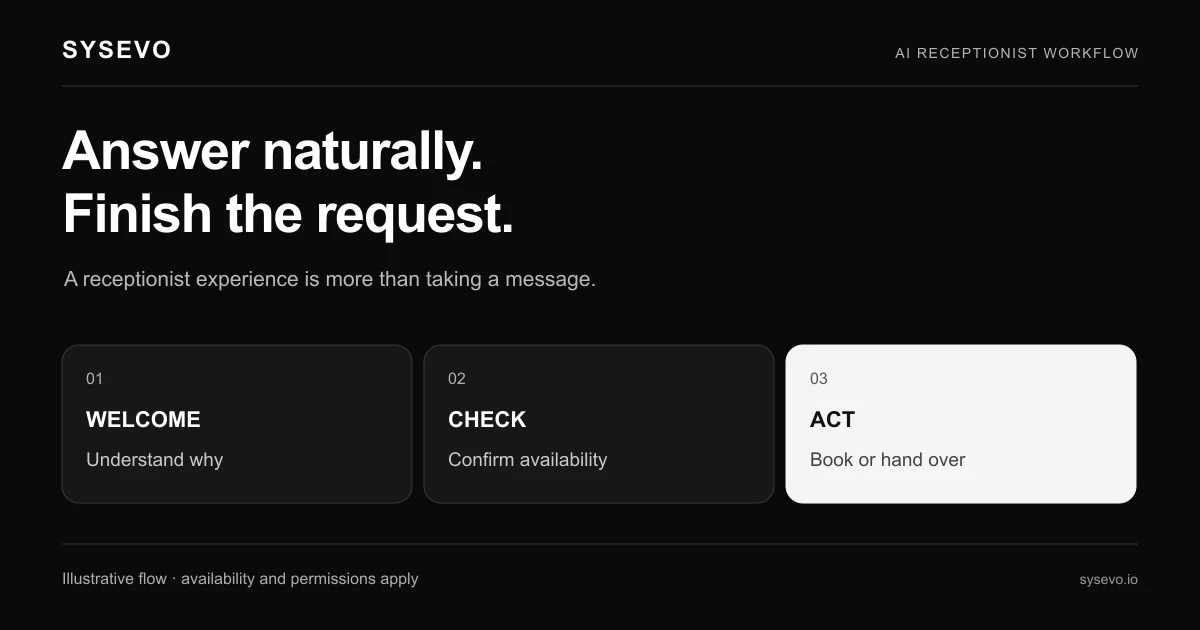
An AI call answering system uses automatic speech recognition and natural language processing to understand what a caller needs, then responds in real time using a voice that sounds natural and conversational. No human receptionist is involved in the initial interaction. Instead, a machine learning model processes the call, extracts intent, and either handles the request directly or transfers to a human if needed. The entire conversation is logged and timestamped, and key data points are written to your CRM automatically.
The technical mechanism differs fundamentally from a bear answering service. When a call arrives, it connects to the AI system within one second. The system plays a greeting while simultaneously loading your business context: current hours, active staff, services offered, and recent caller history. The AI asks clarifying questions, listening for keywords like appointment booking, payment inquiry, or emergency. If the intent matches a task the system can complete, it does so. If the caller needs a human, the AI transfers them immediately with full context available to the operator.
Data capture is automatic and complete. Every call is recorded, every spoken word transcribed, every customer intent classified. This information flows into a built-in CRM without manual entry. A dentist's office receives a call from a patient requesting a specific appointment time. The AI determines availability, books the slot, and sends a confirmation text. The dentist opens their system the next morning to find the appointment already entered, along with the original caller's voice recording and transcript. Zero administrative overhead. This is where the labour cost reduction becomes material.
Scaling an AI system is instantaneous and costless. If you receive 200 calls today and 800 calls tomorrow, the system handles both with identical latency and quality. A human call centre must hire, train, and schedule new staff. If demand drops again, those staff members become redundant. An AI system simply processes fewer calls the next day, with no cost change. This elasticity is particularly valuable for businesses with unpredictable demand: trades responding to storms, clinics managing seasonal illness patterns, or retailers handling promotional surges.
Bear Answering Service and Cost Comparison
A typical bear answering service contract costs £500 per month base fee plus £1.50 per answered call. A business receiving 400 inbound calls per month pays £500 plus £600, totalling £1,100. Add a transfer fee of £0.50 per transferred call on 60 transfers, and the total is £1,130 monthly. Over a year, that is £13,560. The cost is proportional to call volume, so a business receiving 800 calls monthly pays closer to £1,700 per month, or £20,400 annually.
An AI call answering system costs £200 to £600 monthly depending on features and complexity, with no per-call fees. A business receives the same 400 calls per month and pays a flat £350, totalling £4,200 annually. The same business receiving 800 calls per month pays the same £350 monthly. This is the core economic driver. At moderate call volumes, AI costs 60 to 70 per cent less than human services. The break-even point is very low: for most businesses, AI becomes cost-competitive at 150 calls per month.
Labour costs for in-house reception reinforce this comparison. Hiring a full-time receptionist in the UK costs £20,000 to £28,000 annually in salary, plus employer national insurance of approximately 15 per cent, plus equipment and workspace. A productive receptionist works perhaps 35 hours per week across 48 weeks, totalling 1,680 hours annually. That receptionist costs approximately £18 to £20 per hour loaded. A human call centre receptionist is proportionally even more expensive because the centre must employ supervisors, maintain physical infrastructure, and manage scheduling across time zones. This is why bear answering services exist: they pool that cost across many businesses. But an AI system eliminates the labour pool entirely, passing those savings to the user.
Hidden costs with bear services include setup fees of £100 to £300, call reporting charges of £50 to £100 monthly if you want detailed analytics, and premium rates during peak hours or for specialty handling. A practice receiving calls from anxious patients might pay 10 to 20 per cent more for trained medical receptionists rather than general staff. A dental office using a bear service with emergency transfer capability pays an additional £150 to £250 monthly. These layered costs are not transparent at the point of sale but accumulate quickly.
Availability and Response Time
A bear answering service promises availability during contracted hours, typically 8am to 6pm on weekdays, with optional 24-hour coverage at higher rates. During those hours, calls are answered, though response time varies. Industry benchmarks put average answer time at 20 to 45 seconds, depending on queue depth. During peak periods or if the service is short-staffed due to illness or turnover, calls may ring for 60 to 90 seconds before connection. Unanswered calls are not guaranteed; if a service is overwhelmed, calls may drop to voicemail without ever reaching a receptionist.
An AI call answering system answers every call within one second of connection. No queue, no wait, no variable delay. The system is available 24 hours a day, seven days a week by default, with no additional charge for out-of-hours coverage. If you choose to operate only 8am to 6pm, the system can be configured to route after-hours calls to voicemail or an external number automatically. There is no staff illness, no seasonal staffing shortage, no degradation during peak periods. Response time is constant.
This consistency matters for caller experience and business outcomes. Research on call handling shows that callers who wait longer than 30 seconds are significantly more likely to abandon the call entirely. For professional services, a missed call often means a missed contract. A contractor who calls three plumbers and reaches only two is far more likely to book with one of those two. An AI system that answers on the first ring wins that competition. A bear service that answers on the fourth ring loses it.
After-hours availability is particularly important for emergency-adjacent businesses: veterinary practices, construction firms managing site emergencies, IT support desks. A bear service covering true 24-hour availability costs £1,200 to £2,000 per month. An AI system offers the same 24-hour coverage at the standard monthly rate. This cost difference is significant enough to drive business model decisions independently of any other factor.
Data Capture and CRM Integration
A bear answering service delivers data as a message. A caller requests an appointment and provides their name and preferred date. The receptionist writes this in a message: 'Sarah calling re: appointment, wants Wednesday if possible, best time after 2pm.' That message arrives via email or is entered into a shared notepad. Your staff member then manually opens your booking system, searches for availability, calls Sarah back, and books the slot. Three steps, three people involved, time lag of hours or sometimes days.
An AI call answering system extracts the same information and writes it directly to your systems automatically. The caller provides their name and preferred date. The AI searches your calendar in real time, identifies available slots, and either books the appointment directly with confirmation, or transfers the caller to a staff member with the preferred date already visible on their screen. The staff member confirms and the call ends. One step, zero manual data entry, confirmation sent instantly.
This difference compounds across call volume. A medical practice receiving 50 appointment calls per day saves 50 manual data-entry steps each day, or 250 per week. At 5 minutes per entry including search time, that is 1,250 minutes or approximately 21 hours of administrative work per week. Over a year, a single person's worth of labour is saved from better data capture alone. For a business with three people handling appointments, the time freed is material enough to hire fewer staff or redeploy existing staff to more valuable work.
Built-in CRM functionality in modern AI systems means that caller history is automatically available on the second call. A customer calls back three weeks later with a follow-up question. The AI system identifies them from their phone number, loads their previous context, and understands they are calling to follow up on a specific issue. A bear answering service has no such memory. The new receptionist takes a fresh message with no prior context.
Caller Experience and Perception
Many business owners assume that callers dislike speaking to an AI system and prefer human receptionists. In practice, caller preference depends on speed and outcome, not on whether the voice is human. If a caller reaches a human receptionist after 45 seconds and that person sounds rushed or takes incomplete information, satisfaction is low. If a caller reaches an AI system that answers immediately, understands their need, and solves it in 90 seconds, satisfaction is higher.
Perception shifts based on purpose. A caller with a simple, transactional need like rescheduling an appointment or checking business hours is satisfied by a fast AI interaction. They do not need empathy; they need completion. A caller with a complex or emotionally charged issue, like a medical complaint or a billing dispute, prefers a human who can demonstrate understanding and flexibility. The optimal approach uses AI to handle routine calls efficiently and reserves human staff for complex interactions.
Quality of voice matters. A bear answering service uses human voices, which sound naturally variable in tone and pace. An older AI system used synthetic voices that sound robotic or slightly off-rhythm, often triggering immediate distrust. Modern AI voices are far superior; many callers cannot distinguish them from human voices in a blind test. This technology has improved dramatically in the last two years. A system deployed five years ago may sound obviously artificial; a system deployed today does not.
Scripting and personalisation are areas where human receptionists historically had an edge. A receptionist can deviate from a script, make a joke, or acknowledge unusual circumstances. An AI system typically follows a more structured path. However, modern AI systems can be trained with personality quirks and brand voice. A law firm's AI can be configured to sound formal and precise. A salon's AI can be configured to sound warm and enthusiastic. The difference is narrowing, though a skilled human will still sound more naturally adaptive than even a well-trained AI.
Security and Compliance
When you route calls to a bear answering service, you transmit caller information to a third-party facility. That facility must comply with data protection regulations, maintain confidentiality agreements, and implement security practices. Most established services do this well, but you have limited visibility into their operations. You cannot audit their staff or their security practices directly. You rely on their compliance certifications and contractual guarantees.
For regulated industries, this creates friction. A medical practice handling NHS patient calls must ensure that the answering service complies with NHS confidentiality requirements. A financial services firm handling client data must verify GDPR and FCA compliance. The bear service must provide documentation; the business must verify and maintain audit trails. This is feasible but requires active management.
An AI call answering system that runs on your own infrastructure or within a provider's secure data centre under a data processing agreement offers tighter control. You can configure which data is captured, where it is stored, and how long it is retained. Calls can be encrypted end-to-end. Access logs show exactly which staff members accessed caller information and when. For businesses in regulated industries, this transparency is often preferable to outsourcing to a human service.
However, this depends on implementation. An AI system that transmits call audio to multiple third-party vendors for processing sacrifices this advantage. A system that processes all audio locally or within a single provider's controlled environment maintains it. When evaluating an AI system, verify where audio is processed, how long it is retained, and whether the provider holds relevant compliance certifications like ISO 27001 or SOC 2.
When a Bear Answering Service Is Still the Right Choice
Despite the advantages of AI systems, certain businesses remain better served by human call handling. The most important factor is caller complexity. If your typical inbound call is highly variable or emotionally charged, human handling is superior. A social services intake line receives calls from people in crisis. A charity helpline speaks to vulnerable callers needing empathetic listening. A high-end personal services business like executive coaching receives calls from clients who expect bespoke attention. In these contexts, an AI system answering the first interaction would damage brand perception and caller outcomes.
A second scenario is businesses receiving very few calls, perhaps 10 to 20 per month. For these businesses, the fixed cost of an AI system does not produce sufficient ROI to justify switching from a bear service. The labour cost saving on data entry is negligible when you receive one or two calls per week. The availability advantage is irrelevant if you are in-office during business hours. A small legal practice or accountancy receiving only appointment inquiries from existing clients might reasonably stick with a bear service for years without cost disadvantage.
Extreme out-of-hours availability needs favour human services in some cases. If you operate a true 24-hour emergency service and receive calls at 3am from callers who may need immediate human judgment, a 24-hour bear service with trained emergency handlers might be more appropriate than an AI system configured for routine scheduling. However, this is increasingly rare; most emergency-adjacent businesses can route 3am calls to on-call staff directly, bypassing any answering service entirely.
Legacy system lock-in sometimes forces continued use of bear services. If your entire CRM and business system architecture is built around receiving messages from a specific bear service provider, and switching to AI would require rebuilding integrations, the cost of transition might outweigh the benefit. This is a transitional problem; if you are building systems today, you would design around AI integration from the start. But for established practices, this switching cost is real.
Integration with Existing Business Systems
A bear answering service is deliberately system-agnostic. It works the same way whether you use Sage, Xero, Microsoft 365, or anything else. Messages arrive via email, and you decide how to handle them. This simplicity is valuable if your current workflow is established and you do not want to disrupt it. You add a new email inbox, set up rules, and off you go. No technical setup required.
An AI call answering system typically requires integration with your existing systems to deliver its full value. If the AI cannot write directly to your booking calendar, appointment reminders are not automatically sent. If the AI cannot access your customer database, it cannot identify returning callers. If the AI cannot write to your CRM, you lose the data capture advantage entirely. These integrations are usually straightforward with common platforms, but they require some technical configuration.
For businesses already running systems like Pipedrive, HubSpot, or monday.com, integration is often plug-and-play. A business using custom or older software might face friction. This is a genuine consideration in vendor selection. Before committing to an AI system, verify that it integrates with your existing stack or that the vendor offers a roadmap to support your platforms.
The integration advantage is long-term. Once integrated, the AI system becomes part of your operating procedure. Calls flow through the system, data lands in the right place, and staff work with current information. The initial setup investment pays back in weeks through reduced manual work. A bear service provides no such long-term benefit; each message still requires manual review and entry, indefinitely.
Training and Customisation
A bear answering service requires minimal training. You provide your business name, a greeting script, a list of key staff members and departments, and a few routing rules. The service's standard training covers how to answer calls professionally, take messages, and transfer calls. You do not customise the receptionist's behaviour; you accept their standard approach.
An AI system requires more customisation but offers far greater control. You define the greeting, the questions asked, how the AI classifies caller intent, and what it can do without human transfer. For a restaurant, you might configure the AI to take reservations, answer menu questions, and relay booking confirmations via text. For a medical practice, you might configure it to verify insurance eligibility, schedule appointments, and route emergencies immediately to clinical staff. The more specific your configuration, the more value you extract.
This customisation is usually managed through a dashboard or templates rather than code. Most AI platforms now offer no-code configuration. You define the conversation flow visually, assign intents to actions, and test the system before go-live. Setup typically takes one to two weeks. A bear service can be operational within days. If speed to launch is critical, the bear service advantage is real.
Ongoing customisation differs. A bear service requires no adjustments once deployed. An AI system benefits from continuous refinement based on call performance. If 30 per cent of calls are misclassified or transferred unnecessarily, you adjust the training or conversation flow. This iterative improvement is part of maximising ROI, but it also requires active management. Businesses expecting a set-and-forget solution may find this burden unwelcome.
Reliability and Downtime Risk
A bear answering service is distributed across multiple facilities and staff, making it inherently resilient. If one receptionist is sick or one facility loses power, calls automatically route to other facilities. Total service downtime is rare. Operators typically report availability above 99.5 per cent. The risk is not that the service goes offline, but that quality or response time degrades under heavy load.
An AI system running on cloud infrastructure is also highly available, typically 99.9 per cent or better. However, the risk profile is different. If the provider's infrastructure fails or if a software bug is deployed, the entire system can go offline for minutes or hours. This is rare with reputable providers, but it is a discrete risk rather than a gradual degradation. A bear service might slow down; an AI system might stop entirely.
In practice, this risk is low for most businesses because modern AI systems have built-in redundancy and failover. If one data centre fails, traffic routes to another automatically. But you should verify the provider's uptime SLA, their incident response process, and whether they offer fallback options. Some platforms offer integration with alternative voice providers or manual failover to voicemail during outages.
The business impact of downtime differs by business model. A restaurant taking reservations loses booking revenue if the system is down for one hour. A support desk loses productivity if callers cannot reach them. A appointment-heavy practice loses scheduling revenue. For businesses where every call generates revenue or prevents revenue loss, uptime matters intensely. For others, an hour of downtime per month is acceptable. Size your reliability requirements accordingly when selecting a system.
Staffing Flexibility and Scalability
Scaling a bear answering service requires renegotiating your contract or moving to a higher tier plan. Most services allow quarterly or annual upgrades, and new capacity becomes available after a transition period of one to four weeks. If you experience unexpected demand growth, you cannot instantly increase capacity. You are stuck with your current tier until the next upgrade window. This rigidity is a genuine limitation.
Scaling an AI system is instantaneous. If your call volume doubles tomorrow, the system handles it with no quality loss. You only pay more if you upgrade to a higher tier with more advanced features, but the base system scales for free. This elasticity is valuable for seasonal businesses, businesses expecting growth, or businesses with unpredictable demand like trades or crisis services.
Conversely, if your demand drops, scaling down a bear service requires renegotiating, often with a penalty for reducing commitment mid-contract. Scaling down an AI system is equally instant and usually penalty-free. This symmetry makes AI systems better suited to volatile demand patterns.
From a staffing perspective, a bear service insulates you from hiring and managing people. You never interview receptionists or handle payroll. An AI system has no staff; you only manage the system configuration. For businesses uncomfortable managing technology, this is a disadvantage. For businesses already managing multiple systems, it is a non-issue.
Common Integration Scenarios
A dental practice receives 150 inbound calls per month, mostly appointment requests and follow-up inquiries. A bear service costs £500 base plus £225 in per-call fees, totalling £8,700 annually. A staff member spends 10 hours per month manually entering appointment information into the scheduling system and responding to voicemails. That is 120 hours annually, costing approximately £1,200 at £10 per hour, plus opportunity cost. An AI system costs £300 per month, or £3,600 annually, plus approximately 20 hours of setup. By month four, the AI system is cost-neutral and delivering ongoing labour savings. By year two, the practice is saving approximately £6,000 annually.
A trades firm receives 100 calls per month, a mix of inquiries, urgent job requests, and customer follow-ups. A bear service costs £500 base plus £150 in per-call fees, totalling £7,800 annually. Many calls are time-sensitive; a 45-second wait time sometimes costs a job to a faster competitor. An AI system costs £250 per month, or £3,000 annually. Answer time is one second instead of 45 seconds. The firm estimates this wins 2 to 3 additional jobs per month, each worth £500 to £1,000 in revenue. Over a year, the faster answer time generates £12,000 to £36,000 in additional revenue. The AI system pays for itself many times over from speed alone, before accounting for the labour cost savings.
A medical practice receives 300 calls per month, mostly appointment requests, some clinical questions routed to nurses. A bear service costs £500 base plus £450 in per-call fees, totalling £12,000 annually. A receptionist works part-time, 20 hours per week, to handle the administrative overflow. That is approximately £10,000 annually in salary costs. An AI system costs £450 per month, or £5,400 annually. The system books routine appointments, handles clinical triage questions with nurse-trained responses, and routes complex cases to clinical staff. The part-time receptionist is no longer needed; the existing full-time receptionist handles exceptions. Labour saving is £10,000 annually, system cost is £5,400 annually, net saving is £16,600 annually.
A 24-hour emergency support desk receives 500 calls per month distributed across night and day shifts. A 24-hour bear service costs £1,500 base plus £750 in per-call fees, totalling £27,000 annually. You employ three support staff across shifts. An AI system with 24-hour availability costs £600 per month, or £7,200 annually. The system handles basic troubleshooting, password resets, and account queries. Complex technical issues are escalated to humans. The system handles 40 per cent of calls without escalation, reducing the load on human staff and eliminating the need for one full-time person. Labour saving is approximately £25,000 annually, system cost is £7,200 annually, net saving is £17,800 annually.
Choosing Between the Two Models
The decision between a bear answering service and an AI system depends on five factors. First, call volume. Below 100 calls per month, the labour cost advantage of AI is minimal; a bear service is acceptable. Above 300 calls per month, AI is almost always cheaper. Between 100 and 300, it depends on the specific cost structure and your tolerance for technology setup.
Second, call complexity. If most calls are transactional, routine, and have clear outcomes (book an appointment, answer hours, collect information), AI handles them well. If calls are emotionally complex, require deep judgment, or vary wildly in nature, human handling is superior. Most businesses have a mix; AI handles the routine 60 to 80 per cent, humans handle the complex 20 to 40 per cent.
Third, data integration value. If your business systems are already mature and you can integrate an AI system to write appointment bookings, customer records, and follow-ups directly to your CRM, the ROI is high because you eliminate manual data entry entirely. If you have no CRM and integration is not feasible, much of the AI advantage disappears. You still benefit from cost and availability, but not from labour savings on data handling.
Fourth, growth trajectory. If you expect rapid growth or seasonal spikes, an AI system that scales instantly is preferable to a service that requires contract renegotiation. If your call volume is stable and predictable, this advantage is irrelevant.
Fifth, regulatory requirements. If you operate in a regulated industry and data security is a top concern, verify that an AI system offers the control and compliance certifications you need. Some AI providers are better suited to regulated industries than others. A bear service is usually acceptable because humans are trusted entities, but the outsourcing itself creates compliance risk.
The Future of Call Answering Technology
The trajectory is clear: AI systems are improving in capability and falling in cost. Human call centres have structural cost floors related to labour, facilities, and management overhead. AI systems have structural cost advantages that only improve as the technology matures. Within five years, AI systems will likely be the default choice for most businesses receiving more than 50 calls per month. The bear answering service will persist as a specialty service for highly complex, emotionally demanding interactions or for businesses unwilling to adopt technology.
Current developments in large language models are making AI systems more conversational and contextually aware. Systems that today require specific training for each business type will soon learn from experience and adapt automatically. Systems that today require fallback to humans on edge cases will handle more edge cases independently. The trajectory is toward broader autonomy and lower human handoff rates.
Simultaneously, bear answering services are attempting to compete by adding technology. Some now offer cloud-based dashboards, basic CRM integration, and real-time call monitoring. These improvements make them more competitive, but they do not overcome the fundamental structural disadvantage: they still employ humans, and humans are expensive at scale. The evolution of bear services into hybrid models is likely, but pure human services are entering terminal decline.
For businesses evaluating this choice today, the key is to choose based on your current reality, not on where the technology might be in five years. If AI makes sense today, deploy it. If a bear service is the right fit today, use it. The cost and capability gap favours AI, and it will only widen. Review your current call volume and business needs, then compare pricing across options to see where the economics land for you specifically.
Implementing Your Call Answering Strategy
If you decide to move from a bear answering service to an AI system, plan for a transition period. Do not switch on day one; run both systems in parallel for two to four weeks. Route some incoming calls to the AI system while maintaining your bear service as backup. This approach lets you test the AI system with real calls, refine its configuration, and build staff confidence in the technology before fully committing. During the parallel period, capture metrics on call volume, transfer rates, and caller satisfaction to inform your final configuration.
Prepare your team for change. Staff accustomed to receiving detailed messages from a bear service must now work with an AI system that writes structured data to their CRM. This is typically faster and cleaner, but it requires different workflows. Spend time training staff on how to access and use the new data, how to handle transferred calls from the AI system, and what to do when the AI misclassifies a call. Staff buy-in is critical; if the team resists the technology, they will gravitate back to manual workarounds and the labour savings will not materialise.
Set clear metrics before launch. Measure first-call resolution rate, average handling time, customer satisfaction, and cost per call. Measure also the labour time spent on call-related administration. Establish a baseline with your current system, then track improvements with the new system. After 30 days, you should have enough data to know whether the change was positive. If metrics are worse, adjust the configuration. If they are better, optimise further.
Many AI call answering providers offer features beyond answering inbound calls, including automated outbound campaigns for follow-ups and confirmations. Once your inbound system is stable, explore whether these capabilities could improve your business. Appointment confirmations sent automatically via AI reduce no-shows. Follow-up calls after service delivery improve customer satisfaction. These capabilities are available even if you decide to keep your bear answering service for inbound calls, though the integration and labour cost savings are less than with a full AI system.
Evaluating Specific AI Providers
When evaluating AI call answering systems, focus on these capabilities: Can the system understand your specific industry terminology and context? A system trained only on general conversations will misclassify medical or legal inquiries. Does the system offer easy-to-use configuration tools, or does it require technical expertise? Can you build conversation flows without writing code? How does the system handle edge cases or unusual requests? Does it escalate to humans gracefully, or does it get stuck in loops? What data does the system capture and where is it stored? Can it integrate with your existing CRM, calendar, and billing systems?
Evaluate the provider's reliability claims carefully. Ask for their SLA, their incident history, and their redundancy architecture. Ask how they handle downtime and whether they offer fallback options. Request references from businesses similar to yours; ask them about real-world uptime, about unplanned outages, and about the vendor's responsiveness when problems occur. Do not rely on marketing promises; rely on evidence from customers operating at scale.
Consider also the pricing model. Most AI providers charge per-month with no per-call fees. Some charge per minute of call time. Some charge based on number of advanced features used. Understand which model aligns with your business. If you have high call volume but short calls, per-minute pricing might be cheaper. If you have variable call volume, monthly flat-rate pricing is more predictable. Calculate your expected monthly bill under each model and compare.
Some AI providers offer white-label solutions where you can rebrand the system and resell it as your own service, which might open revenue opportunities if you operate in an industry where call answering is a sellable service. This is a secondary consideration, but worth evaluating if you have a partner or customer base that might value it.
Frequently Asked Questions
Can an AI call answering system completely replace human receptionists?
For 60 to 80 per cent of routine calls, yes. For complex, emotionally charged, or unusual situations, no. Most deployments use AI to handle routine volume and reserve human staff for exceptions. This hybrid approach reduces headcount and cost while maintaining quality for difficult interactions.
What happens if the AI system misunderstands a caller?
The system is configured to escalate uncertain calls to a human agent. If a caller's request does not match any trained intent, or if the confidence score is low, the AI transfers to a person rather than giving a wrong answer. This safety mechanism means that misunderstandings rarely result in bad outcomes for the caller; instead, they consume a bit more human time than ideal.
How long does it take to set up an AI call answering system?
Simple setups, particularly for scheduling and basic inquiries, take 1 to 2 weeks. More complex implementations, particularly with CRM integration or industry-specific training, take 3 to 4 weeks. Most of this is configuration and testing, not software installation. You can often have calls routed through the system within days, then refine the configuration over subsequent weeks.
Do callers prefer speaking to humans or AI?
Callers care about getting their problem solved quickly. If a human is slower or less helpful, callers prefer AI. If a human is faster and more helpful, callers prefer the human. With modern voice technology, most callers cannot tell the difference if they do not know in advance. Preference is driven by outcome and speed, not by whether the voice is human.
What if I want to keep my bear answering service but add an AI system for overflow?
This is technically feasible but logistically complex. You would need to route calls to the AI system first, then overflow to the bear service if the AI cannot handle the request. Most businesses find it simpler to move completely to one system or the other rather than maintaining dual infrastructure. Hybrid approaches are possible but typically not recommended for small to medium-sized businesses.
How does an AI system handle emergency calls?
AI systems can be configured to identify emergency keywords and route those calls immediately to a designated emergency contact or human operator without delay. Some systems are integrated with emergency dispatching services. However, for truly critical emergencies like someone calling with chest pain, a system that routes to a trained emergency operator is preferable to any answering service, AI or human.
Can an AI system work across multiple businesses or locations?
Yes. Many AI platforms are designed to handle multiple brands, departments, or locations from a single system. Calls are routed to the correct business context, and each can have its own greeting, workflows, and escalation rules. This is useful for groups, franchises, or multi-location operations wanting to manage call handling at scale.