
Retell AI is a voice-agent platform for inbound and outbound calls. Its official product material describes real-time phone agents and a platform built around configuring and deploying them. That makes it a relevant option for businesses considering automated calls. It does not tell you whether a particular agent will complete your booking, update your customer record or handle an exception correctly.
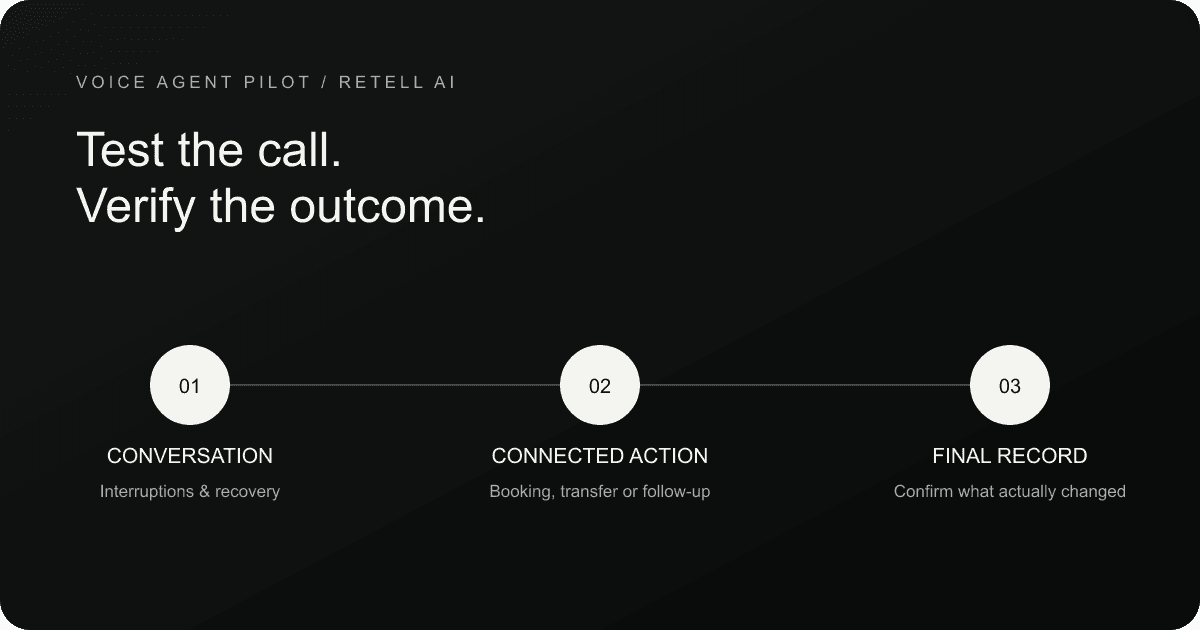
The useful question is not whether an AI can hold a conversation. It is whether the complete call ends in the right, verified business outcome. Run these seven tests against the workflow you actually need before choosing a platform.
Scope: This guide reviews public product information and gives you a pilot checklist. We have not independently benchmarked Retell AI or tested a customer deployment. Confirm current functionality and terms with Retell before making a purchase.
What Retell AI says it provides
Retell describes its product as a platform for building and deploying AI phone agents, including inbound and outbound calling. Its public materials cover voice-agent setup and telephony. Those descriptions help establish that it belongs on a shortlist; they are not proof that a specific integration, language, region or call flow is available on the plan you need.
Start with the official AI phone agents overview and pricing page. Ask the vendor to confirm the exact components in your quote, including model and voice usage, telephony, concurrency, support and optional services. Pricing structures can change, so compare a dated quote for the same workload rather than relying on a single per-minute headline.
Seven tests to run before launch
| Test | What to try | What a successful result looks like |
|---|---|---|
| 1. New booking | Ask for an available appointment, then confirm the date and time in the calendar. | The caller hears a clear confirmation and the correct event exists in the system of record. |
| 2. No availability | Request a slot that is unavailable. | The agent offers an allowed alternative and does not imply a booking was made. |
| 3. Changed details | Correct a name, phone number or appointment detail mid-call. | The final record contains the corrected value, with the change visible to staff. |
| 4. Caller context | Return as a caller with an existing record or preference. | The right person is identified under your verification rules and relevant context is used appropriately. |
| 5. Tool outage | Make the scheduling or CRM action fail during the test. | The agent explains the issue honestly, avoids false completion and creates an owned next step. |
| 6. Human handoff | Ask for a person or describe an exception the agent should not handle. | The transfer or follow-up follows your policy and preserves useful call context. |
| 7. Repeat and edge cases | Interrupt, speak a date unclearly, call after hours and repeat a request. | The agent clarifies uncertainty and follows the same business rules across variations. |
Record both the conversation and the final system state for every test. A polite answer is not a successful booking if the calendar did not change. Likewise, a correct calendar event is not enough if the caller received the wrong confirmation.
Map the work around the voice agent
Before a pilot, write down what starts the call, what information the agent may use, which actions it may take, and who owns failed actions. Identify the source of truth for customer identity, appointments and consent. Decide how staff will review uncertain calls and correct mistakes.
Then estimate the cost of the full workflow. Include connected call minutes, attempted calls where relevant, telephony, models, voices, integrations, support and the staff time needed to maintain the system. Compare cost per verified completed outcome, not just cost per minute. Use the same call volume, duration and success definition for every shortlisted option.
When to shortlist Retell AI
Retell AI is worth evaluating if your team wants to configure phone agents and has the people or partner support needed to own the connection between calls and business systems. Your pilot should establish which integrations and deployment responsibilities are included for your use case. If you need an integrated operating model, compare those responsibilities explicitly with Sysevo Voice, alongside your requirements for customer records and caller context. A wider shortlist might also include Zanus AI: its official AI Phone overview presents phone automation within Front Office alongside CRM and booking tools. Check which functions are included in the current quote, then run the same call scenarios against each option. Our Zanus voice-agent evaluation is a separate buyer checklist, not a hands-on review.
This is a workflow comparison, not a claim that one product cannot perform a particular task. Check current configurations and plans with both providers, then judge the result using your own call scenarios and records.
A simple go or no-go scorecard
For each of the seven tests, record: pass, partial or fail; evidence from the call; evidence in the system of record; the person who owns a failure; and any extra setup or recurring cost. Decide your launch threshold before the demo. If the agent confirms an action that did not happen, treat that as a failed test, even if the conversation sounded natural.
For a broader feature and operating-model comparison, see Retell AI and Sysevo. Verify the current details directly with each provider before selecting a platform.
Sources
- Retell AI phone agents, official product information, accessed 5 October 2026.
- Retell AI pricing, official pricing information, accessed 5 October 2026. Pricing and plan details can change.


