Vapi provides a platform and APIs for building voice agents. Its documentation describes configurable tools, phone setup and outbound calls. That flexibility can suit teams that want control over how an agent connects to services and business logic. The practical decision is whether your team can build, test and operate the complete phone workflow you need.
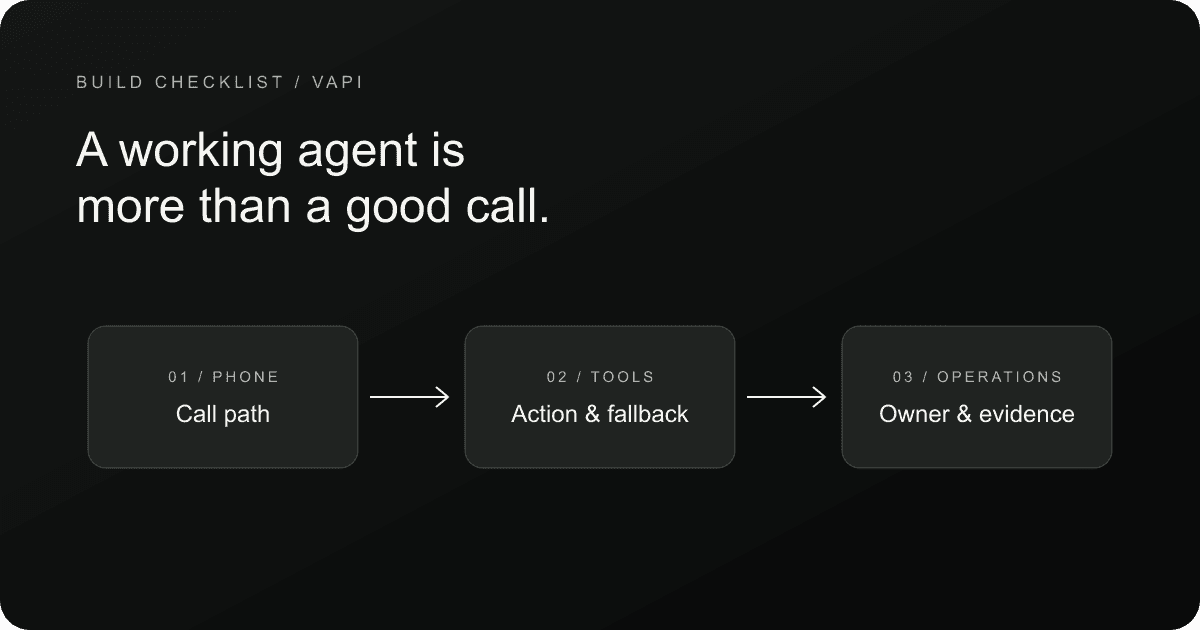
Use these six checks to evaluate the work behind a Vapi deployment. They focus on whether a call can safely complete a business task, not just whether the agent can answer a question.
Scope: This guide is based on public documentation and an evaluation framework. We have not independently benchmarked Vapi or tested a customer deployment. Confirm current capabilities, integrations, terms and support with Vapi.
What the public documentation shows
Vapi documents configurable tools, phone setup and outbound calling. Its integration documentation describes connecting tools and services, including examples such as calendar availability. The implementation details and requirements depend on the chosen tool and deployment. Review the current docs and confirm the exact setup with Vapi before planning around a specific integration.
These capabilities make Vapi a relevant choice to investigate when developers want to shape the agent and its connections. They do not, by themselves, establish how much engineering effort your use case will take or who will maintain it after launch.
Six checks before you build
| Check | Question to answer | Evidence to collect |
|---|---|---|
| 1. Call path | How does a call arrive, and what phone configuration, regions and transfer rules are required? | A working inbound test and a documented route for no answer, busy and transfer failure. |
| 2. Business action | Which service performs the booking, lookup or update? | A successful test visible in the system of record, plus the permissions and inputs required. |
| 3. Tool failure | What happens when a webhook times out, returns invalid data or is unavailable? | A safe response, bounded retry behaviour and a named person or queue for follow-up. |
| 4. Caller identity | How will the system find the right person and protect sensitive information? | A documented verification flow, tested with a wrong or ambiguous match. |
| 5. Conversation recovery | Can callers correct details, interrupt, change their request or ask for a person? | Recorded scenarios showing accurate recovery and appropriate escalation. |
| 6. Ongoing ownership | Who updates prompts, integrations, phone settings, monitoring and incident handling? | Named owners, access controls, review process and an estimate of recurring work. |
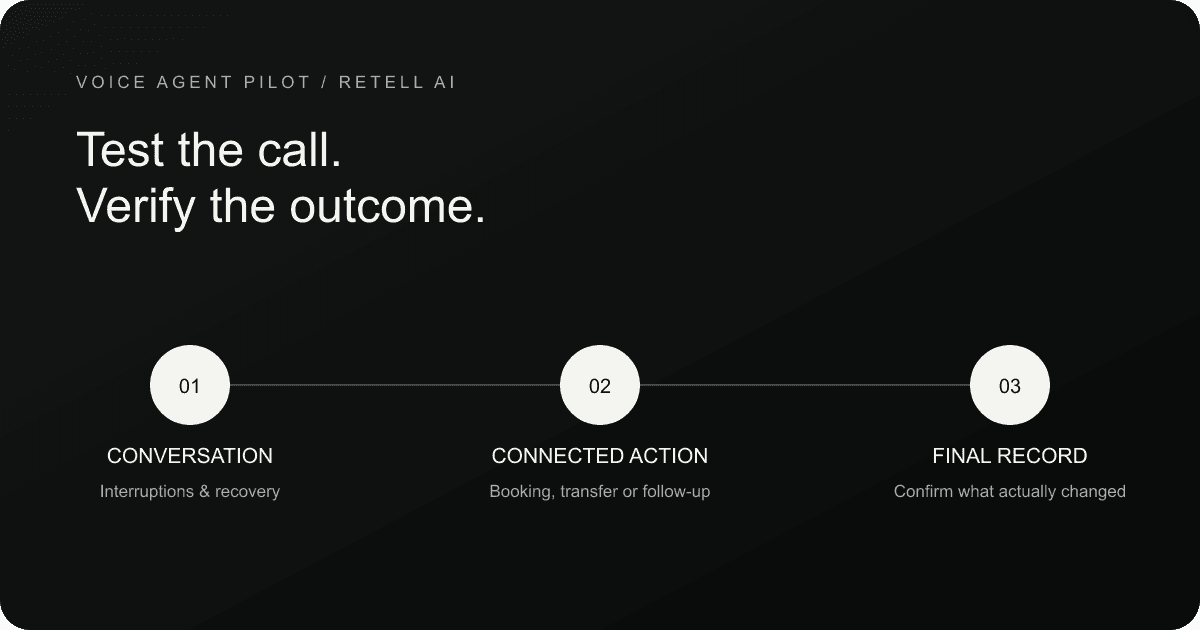
For an appointment workflow, test an available slot, an unavailable slot, a reschedule and a service outage. Check the calendar after each call. Also test what the caller hears when the action cannot be confirmed. A system should not present a requested action as complete until it receives reliable confirmation.
Estimate the real build and operating effort
List the components your team will own: agent configuration, phone numbers and routing, tool endpoints, business-system credentials, monitoring, analytics, testing and fallback processes. Ask Vapi which support and deployment services apply to your account and workload. Estimate implementation and maintenance separately; a prototype can be quick while production support and edge-case handling need continued ownership.
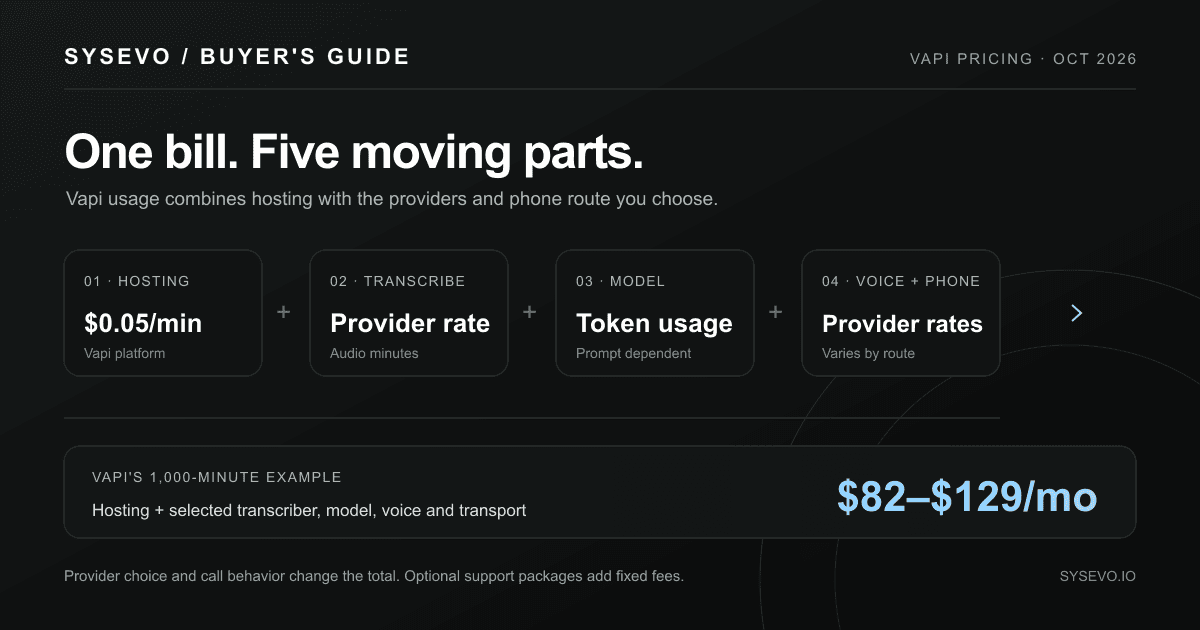
For a fair cost comparison, model the same expected call volume and duration across options. Include telephony, model and voice usage, infrastructure, integration maintenance, support and staff review. Compare cost per successfully completed and verified business task. Avoid treating a vendor's advertised starting rate as the full operating cost of your workflow.
Who should consider Vapi?
Vapi is a candidate to evaluate if your team values control over agent setup and can own or procure the engineering needed for the tools, telephony and ongoing operations. If your priority is a connected platform with business functions already in the same operating environment, compare the responsibility split with Sysevo Voice, its developer tools and CRM. Zanus AI is another option to assess when you want to compare an integrated Front Office model: its official AI Phone overview describes phone automation alongside other business tools. Verify the exact setup and terms against the live pricing page. Use the same test calls and final-record checks for every provider; our Zanus voice-agent evaluation gives a separate test checklist.
This does not imply Vapi cannot support managed or enterprise deployments. Its offer may vary by account and use case, so ask directly about implementation help, support and ownership before comparing.
Make the decision with evidence
Run the six checks with realistic call scripts and a test environment. Score each as pass, partial or fail, and retain call recordings, tool responses and final records as evidence. Set a minimum acceptance threshold before the demo, including a zero-tolerance rule for false confirmations on critical actions.
For a wider feature and operating-model view, read Vapi and Sysevo. Recheck the Vapi tools, phone quickstart and outbound calling guide before publication because product documentation evolves.
Sources
- Vapi tools, official documentation, accessed 5 October 2026.
- Vapi phone quickstart, official documentation, accessed 5 October 2026.
- Vapi outbound calling, official documentation, accessed 5 October 2026.
- Vapi integrations, official documentation, accessed 5 October 2026.