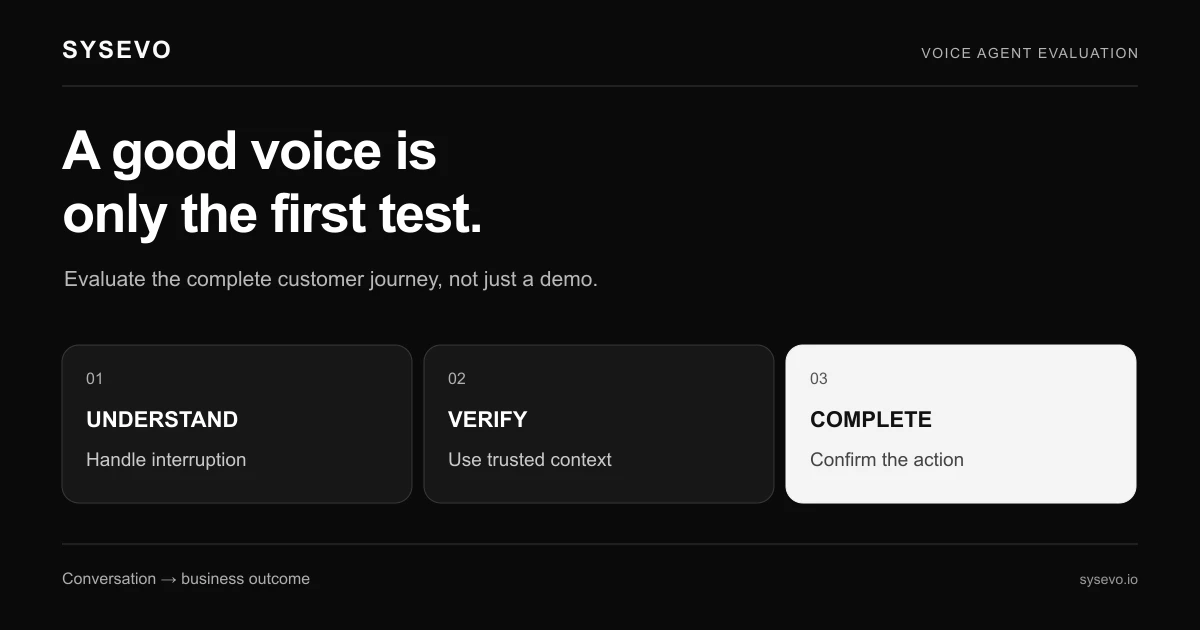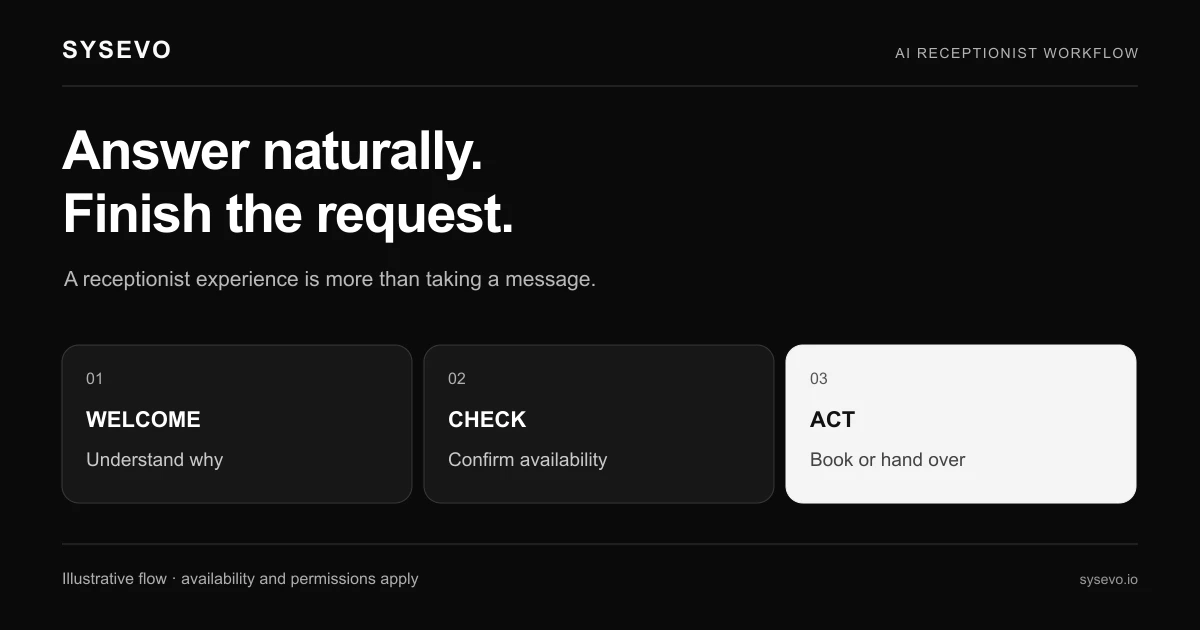

Claude AI is a large language model that powers conversational intelligence in business applications, including AI phone agents that answer calls, understand customer intent, and take action without human intervention. Unlike older rule-based systems, Claude AI learns context from a conversation, adapts to different caller types, and can reason through complex requests in real time.
For business owners, the practical application is straightforward: instead of a missed call or a queue, a virtual receptionist picks up on the second ring, understands why someone called, writes the details to your built-in CRM, and books the follow-up meeting. The question isn't whether the technology exists. It does. The question is whether it makes economic sense for your operation, and that depends entirely on call volume, the types of calls you receive, and how much a missed call costs you.
How Claude AI Powers Voice Agents
Claude AI processes natural language at scale, meaning it can understand casual speech, accents, background noise, and vague requests without requiring the caller to repeat themselves or navigate a menu. Traditional IVR systems ask callers to "press 1 for sales, press 2 for support." Claude AI listens to what the caller actually says and routes them (or resolves their issue directly) based on meaning, not keypresses. The model runs inference on the call in near-real-time, with latency typically under 1.5 seconds between the caller finishing a sentence and the agent responding.
The underlying mechanism works like this: audio enters the system, gets transcribed into text, and Claude AI processes that text alongside the call context (who is calling, what have they called about before, what's in their account). The model generates a text response, which is then converted back to speech and played to the caller. All of this happens in a single conversation loop. If the caller's request is outside the agent's scope (say, a technical question that needs a specialist), Claude AI can recognise that and queue them for a human, or offer to schedule a callback with someone qualified to help.
The key advantage over rule-based systems is flexibility. A rule-based bot needs explicit instructions for every scenario. Claude AI generalises from its training and can handle variations and unexpected phrasing without additional rules. If a caller says "I need to reschedule my appointment because my car broke down," Claude AI understands the intent (reschedule) and the reason (for context), whereas older systems would struggle if that exact phrase wasn't in their rule set.
Real-World Use Cases for Claude AI in Business
A dental practice with three locations and 2,000 active patients receives roughly 80 calls per day. At least 35 of those are appointment-related: booking a new visit, rescheduling, or checking when the next opening is available. A human receptionist spends 4 hours per day just answering the phone, and calls still drop during lunch or after hours. With an AI agent powered by Claude AI, those 35 routine calls are handled automatically, written to the practice management system in real time, and confirmed via SMS. The receptionist now spends time on complex cases, billing issues, and relationship-building.
A B2B software company gets 40 inbound calls per day from prospects, and 30 of them are early-stage: "Tell me about your pricing," "Do you integrate with Salesforce?" "Can you send me a demo video?" A virtual receptionist AI agent answers these calls, qualifies the prospect (company size, industry, use case), sends relevant materials, and either books a call with sales or logs the lead for the sales team to follow up later. Sales now spends zero time on information requests and 100 percent of time on conversations with qualified prospects. Lead response time drops from 24 hours to under 60 seconds.
An emergency veterinary clinic operates 24/7 but has no way to staff a receptionist around the clock. Calls after 9 PM currently go to voicemail. A Claude AI voice agent answers every call, collects the pet's symptoms and owner contact details, assesses urgency using a triage prompt, alerts the on-call vet to critical cases via SMS, and books the appointment or schedules a callback during business hours. No call is lost, and the on-call vet gets actionable information 10 minutes before the owner arrives, not after they're already waiting.
Integration with CRM and Data Capture
The power of a voice agent disappears if the data goes nowhere. An AI phone agent's real value comes from its ability to write directly into your CRM, creating or updating a contact record in real time during the call. When a prospect calls and says "I need a quote for your professional tier," the agent records the product interest, the intent, the callback number, and the best time to reach them, all without the caller knowing they're being logged. After the call ends, the data is already in your system, tagged and ready for the next team member to act on.
Most industry applications require integration with specific CRM platforms. A dental practice might use Dentrix or Eaglesoft. A plumbing company might use Jobber. A sales team might use HubSpot or Pipedrive. Claude AI voice agents can be configured to post data to any CRM with an API, or to trigger outbound campaigns based on call outcomes. If a caller books an appointment, the agent can immediately send a confirmation email with directions and a payment link. If a prospect declines and says "maybe later," the agent can queue them for a follow-up call in two weeks.
Capture accuracy matters more than you'd expect. A standard transcription error rate across the industry runs 3 to 5 percent for clear English speech, higher for accents or background noise. At 80 calls per day with a 4 percent error rate, you're looking at three corrupted records per day. Most errors are minor ("John Smith" becomes "Jon Smith"), but some are mission-critical (a phone number wrong by one digit makes the lead unreachable). Claude AI's reasoning capability can catch and flag uncertain transcriptions, asking the caller to confirm uncertain information before writing it to the CRM.
When Claude AI Isn't the Right Tool
Not every business should deploy a voice AI agent, and it's important to be honest about that. If you receive fewer than 20 calls per day and your team has capacity to answer them, the ROI is close to zero. The cost of AI agent setup, platform fees, and integration ranges from £800 to £3,500 upfront, plus £150 to £500 per month depending on call volume and features. A small business with 10 calls per day would need three years to break even on the investment, assuming nothing changes.
Industries with very high-touch, complex conversations also struggle with current AI agents. Family law firms, financial advisory for high-net-worth clients, and executive recruitment all require human judgment, empathy, and context that an AI agent cannot reliably provide. An AI agent can screen the call and gather basic information, but the core conversation still needs a human. If your business model is built on the partner relationship and personal touch, an AI agent feels impersonal to your customers and won't improve your service perception.
Regulatory environments also create friction. Healthcare (HIPAA in the US, GDPR in the EU) and finance (PCI for payment data) have strict rules about how customer data can be handled and stored. An AI agent trained on general internet data might inadvertently reveal information or handle sensitive details in ways that violate compliance. Some industries are starting to solve this with private deployments and data residency controls, but those costs jump significantly. A regulated business should budget for legal review before deployment.
Cost and Setup Timeline
Setting up a Claude AI voice agent takes 2 to 4 weeks from contract to first call. The first week is discovery: what calls do you receive, what data do you need to capture, which systems does it integrate with. The second week covers agent design and prompt engineering, where specialists write the instructions that govern how your agent behaves. Weeks three and four are integration, testing, and tuning. You're not buying off-the-shelf software; you're building a system tailored to your operation.
Pricing follows a usage model. Most platforms charge a setup fee (£1,000 to £3,000), a monthly platform fee (£200 to £500), and a per-minute fee for agent usage (typically £0.30 to £0.80 per minute of live call time). A business taking 60 calls per day averaging 4 minutes each (240 minutes) would incur roughly £72 to £192 in call costs per month, plus the fixed platform fee. Total annual cost would be £3,200 to £8,000. Compare that to one part-time receptionist at £12 per hour, 20 hours per week (£40,000 annually), and the economics become clear for any operation above 40 calls per day.
Hidden costs exist. Your team will need training on how to hand off calls to the agent, how to use the CRM integration, and how to flag calls that the agent mishandled so the system can learn. Most implementations discover that 5 to 10 percent of calls still need human intervention, and there's a learning curve to deciding which ones. Budget 20 to 40 hours of internal staff time in the first month to get your workflows stable.
Claude AI Capabilities and Limitations
Claude AI excels at information retrieval, classification, and decision-making within guardrails. It can answer "What are your hours of operation?" by looking up a webpage, classify "I want to cancel my subscription" as a churn risk, and decide "This caller is upset; offer a discount or escalate to a manager." It performs these tasks faster and more consistently than a new human receptionist.
What Claude AI struggles with: emotional manipulation (a skilled user can sometimes trick the agent into promises it shouldn't make), domain-specific jargon (medical terminology or highly technical product specs), and very long or complex conversations that require following a thread across 20 or 30 exchanges. An agent that handles appointment bookings performs well. An agent that negotiates contract terms or diagnoses a technical problem usually fails or makes costly errors.
Call quality also depends on infrastructure. The agent's voice needs to sound human enough that the caller doesn't feel they're talking to a robot (modern text-to-speech is good but not perfect). Background noise, accent variation, and connection quality all affect transcription accuracy. If your callers are in noisy environments, results may suffer. A support line for outdoor workers will have higher error rates than a sales line in a quiet office.
Choosing the Right AI Voice Platform
Several platforms now integrate Claude AI or similar models for voice agent applications. Some operate as managed services, where you describe your use case and they build and maintain the agent. Others provide infrastructure and tools where you or your team controls the prompting and design. Some include CRM functionality (like Sysevo's built-in CRM); others require you to integrate a third-party system.
Evaluate platforms on these criteria: integration flexibility (does it connect to your existing CRM without custom API work?), accuracy in your specific use case (audio quality, accents, domain terminology), handoff quality (how well does it transition to a human if needed?), and support responsiveness (when something breaks, how fast can they help?). Request a pilot with your actual call recording, not a demo scenario. A platform that works great on clean, scripted calls might fail on your messy, real-world calls.
Cost transparency matters. Some platforms hide per-minute costs or charge for premium features that should be standard. Ask explicitly for a 90-day total cost estimate based on your call volume. Factor in the implementation time and your internal staff cost to get it live. If a vendor won't give you a number, that's a red flag. You're evaluating plans and pricing to make a business decision, not taking a vague promise.
Getting Started with AI Voice Agents
If you're considering this technology, start with three questions: How many calls do we receive per week? What percent of those are repetitive or information-based? What does a missed or poorly handled call cost us? If you can't answer the third one with a number (lost sales, rescheduled appointments, escalated complaints), the project isn't ready yet. Go count your call volume and classify your calls for two weeks. That data alone will tell you whether voice AI makes sense.
Next, map your current workflow. Where does call data live today? How does it get from the receptionist's notes into your CRM? What systems does it integrate with? An agent is only as good as the system it connects to. If your CRM is outdated or your integrations are fragile, fixing those problems must come first.
Finally, talk to someone who has implemented this in your industry. A dental practice that deployed an AI agent can tell you what worked and what didn't. An accountancy firm's experience won't transfer directly to a law firm. Industry-specific pain points and caller behaviour vary enough that peer experience is worth more than generic case studies. When you're ready to evaluate book a call with a platform that operates in your space and can answer specifics about your use case.
Frequently Asked Questions
Does Claude AI sound human on a phone call?
Modern text-to-speech voices sound human enough that most callers don't realize they're talking to an AI, especially in the first 30 seconds. Some systems now disclose that the caller is speaking to an AI agent, which is required by law in some jurisdictions. Voice quality varies by provider; better platforms invest in multiple voice options and natural prosody (pacing and intonation).
How long does it take for the agent to respond to a caller?
Latency from the end of the caller's sentence to the start of the agent's response is typically 0.8 to 1.5 seconds. Humans often pause longer when thinking, so the delay feels natural. Connection quality, transcription accuracy, and model response time all contribute to latency. Latencies above 2 seconds start to feel uncomfortable to callers.
Can Claude AI handle calls in languages other than English?
Yes, but accuracy and naturalness vary by language. English, Spanish, French, and German perform well. Languages with fewer training examples (Mandarin, Arabic, less common European languages) may have higher transcription error rates and less natural speech synthesis. Test in your specific language before committing to a full deployment.
What happens if the agent doesn't understand a caller or makes a mistake?
Most systems allow the caller to say "agent" or "representative" to transfer to a human immediately. The agent's conversation history transfers with the caller so the human doesn't have to start over. For mistakes (wrong data, wrong routing), the conversation is logged and reviewed by operations, and the system is adjusted so similar mistakes don't happen again.
Is Claude AI secure enough for sensitive customer data?
Security depends on the platform's architecture and compliance certifications. Data in transit and at rest should be encrypted. Ask whether the platform is ISO 27001 certified, SOC 2 compliant, or has passed security audits. For healthcare or financial data, verify HIPAA or GDPR compliance before deployment. Some platforms use on-premises deployment to keep data off public clouds.
How much training data does my team need to provide?
You don't train Claude AI itself; you prompt it with instructions specific to your business. The vendor needs your call scripts (or examples of your typical calls), your CRM schema (what data fields exist), your decision trees (when to escalate, when to book an appointment), and your tone of voice guidelines. Typically 5 to 10 hours of your time to provide this information.