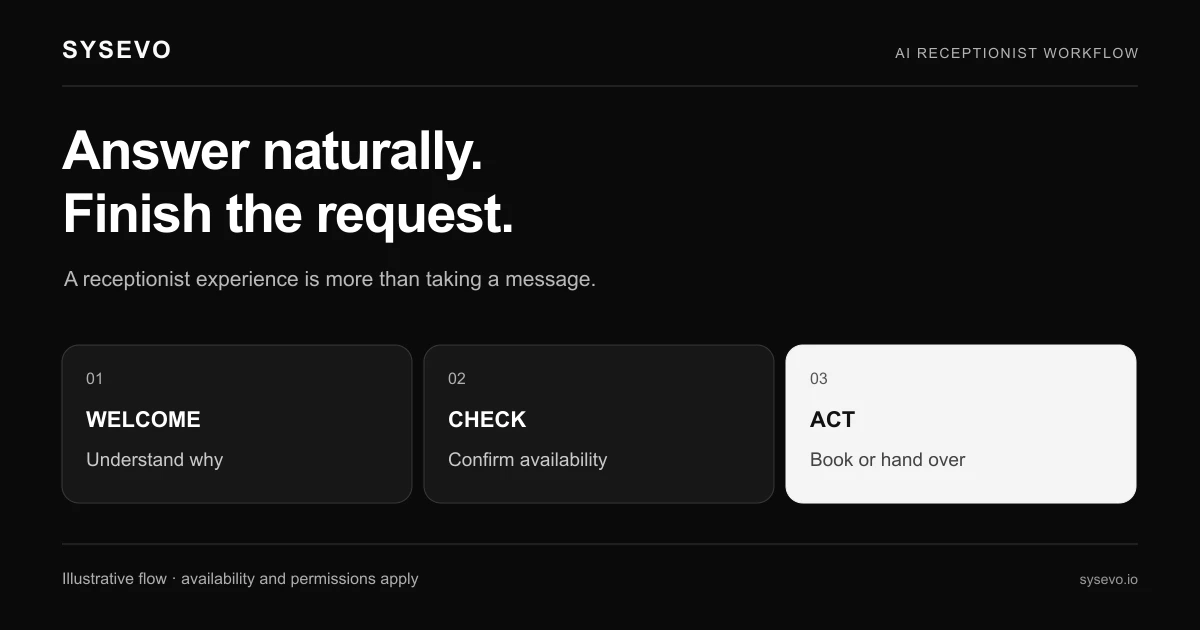

Businesses are adopting AI receptionists to handle incoming calls, capture details, and schedule appointments without hiring staff. But performance varies sharply depending on call volume, industry, integration readiness, and which platform you choose. This article covers what real businesses report when they deploy this technology, where it delivers measurable savings, and where it falls short.
The value of reading actual AI receptionist reviews lies in seeing the gap between feature claims and operational reality. A system that picks up calls at scale might struggle with complex queries. One that integrates seamlessly with your CRM might cost more than a basic call logger. Understanding what others have experienced helps you avoid the most common failure modes and spot the genuine wins in your own context.
What Counts as Success in AI Receptionist Reviews
Businesses measure AI receptionist performance against three core metrics. First: call handling rate, measured as the percentage of incoming calls answered without human intervention before the caller hangs up or requests a person. Industry benchmarks place this at 60–75% for general inquiries and higher for simple appointment scheduling. Second: data capture accuracy, where the system records caller name, phone number, reason for contact, and preferred callback time. Third: time to first human response after a call is logged, typically expected to fall from 30+ minutes to under 5 minutes when the AI feeds data directly into your workflow.
What operators typically report is not a single success rate across all calls, but a tiered one. Simple requests ("book an appointment for Thursday") complete 80–90% of the time. Moderately complex ones ("I need to reschedule and also ask about pricing") complete 50–65%. Highly specific or unusual requests ("this is about the invoice from three months ago and the part number is...") drop to 15–30% autonomous resolution. Understanding this distribution matters more than a headline success rate, because it determines how much staff time you actually save and whether the system reduces wait times or simply redistributes calls.
Honest reviews also mention failure modes. The system might pick up every call but misunderstand the intent on 20% of captures, requiring a human to call back and ask again. Or it might handle calls well but fail to write data to your CRM, forcing staff to re-enter information manually. These hidden costs (the callbacks, the re-keying, the follow-ups that take longer because context is missing) are what separate a system that looks impressive in a demo from one that delivers real operational gain.
Real Feedback on Call Handling and Accuracy
A dental practice with three operatories and an admin team of two reported that their AI receptionist answered 72% of incoming calls end-to-end: new patient inquiries ("what are your hours and do you take insurance?") and appointment reschedules. The remainder required a human touch because patients asked about specific treatments, financing options, or had unusual scheduling constraints. The practice's average call wait time fell from 4 minutes to 8 seconds for questions the AI could answer, and calls requiring human response now arrived pre-screened with full intent captured, cutting the admin team's average handling time per call from 6 minutes to 3 minutes. The net result: 6 hours of weekly staff time reclaimed and fewer missed calls during lunch breaks.
An accountancy firm with a 40-person team reported lower success. They deployed an AI receptionist expecting it to handle routine inquiry calls during tax season, when their office lines became saturated. The system managed simple calls well: "can I book a consultation?" and "what do you charge for a corporation tax return?". But 45% of incoming calls involved existing clients asking about document status, referrals, or specific account details. The AI couldn't retrieve context from previous conversations or access client files, so it defaulted to "let me take your information and have someone call you back." This gave them volume relief but not the hoped-for proportional time saving, because the callbacks still took staff time and the callers felt they'd already explained their issue. Their review of the experience: valuable in surge moments, but not a general receptionist replacement.
A home services company (plumbing dispatch) achieved 88% autonomous call completion. The nature of incoming calls made this possible: customers reporting a problem, getting a price estimate, and booking a technician slot. The AI captured location, symptom type, severity, and preferred appointment window in a single call, then wrote directly to the dispatch system. Staff reviewed the data for quality but didn't need to re-interview the customer. The company reported that this reduced callback volume by 34% compared to their previous answering service, because customers didn't have to explain twice. What their review noted: this works because the call script is predictable and the outcome (appointment booking) is transactional.
AI Receptionist Reviews Across Different Industries
A veterinary clinic with moderate appointment demand (15–20 calls per day) found the system effective for appointment scheduling and after-hours inquiry logging. The clinic uses a 6-week booking schedule for elective procedures and vaccinations, so customers calling to check availability don't need to speak to staff in real time. The AI captured requests, the practice reviewed the queue the next morning, and staff booked appointments from the pre-screened list. However, emergency calls during hours (limping dog, possible toxin exposure) still required live answering because the AI couldn't triage urgency reliably. The practice's conclusion: the tool solved the administrative scheduling bottleneck but didn't replace live support for urgent cases.
A financial advisory firm with 12 advisors reported that their AI receptionist struggled with intent recognition. Callers might say "I want to talk about my portfolio" without revealing whether they wanted performance information, rebalancing advice, or help with a specific holding. The AI logged the call, but staff had to listen to the voicemail to understand context. The system added friction rather than removing it because the firm's value prop requires listening to nuance early in the conversation. After six months, they deprioritised the tool for inbound calls and instead use it for outbound appointment reminders and follow-ups, where the message is fixed and context isn't needed.
A recruitment agency discovered that AI receptionists work well for pre-screening candidate inquiries ("I'm calling to apply for the marketing role") but poorly for client calls (hiring managers with bespoke requirements). They've tiered the system: simple queries about open positions are handled by the AI, but calls from companies registered as active clients are routed directly to staff. This hybrid approach keeps the savings where they exist (reduced staff time on volume inquiries) without forcing the AI to handle conversations that require judgment and relationship context.
Pricing and ROI from User Feedback
An AI receptionist platform typically costs between £200 and £600 per month depending on call volume allowance and feature tier. At the lower end, you might get 500–1000 inbound call minutes per month. At the higher end, 3000–5000 minutes. Most platforms charge additional fees if you exceed your allocation, usually at £0.05–£0.12 per minute overages. Some, like Sysevo, bundle the system with a built-in CRM to avoid paying for separate software integration.
A 10-person services business receiving 40 calls per day (800 monthly calls, roughly 150 minutes) reported that a £300 platform paid for itself within 3 months by reclaiming 8 hours of staff time per week. Their baseline was an answering service costing £180 per month; the AI system cost more but delivered richer data capture and fewer repeat calls. A larger firm with 100 daily inbound calls (2000 monthly calls, roughly 400 minutes) would pay £450–£500 per month and save 15–20 staff hours weekly, offsetting the cost within 2–3 months if they were previously using live reception or an external answering service.
The hidden ROI variables are integration and handoff quality. If your AI receptionist system doesn't connect to your CRM or scheduling tool, staff spend 10–15 minutes per day re-entering data that the AI captured but they can't see automatically. If handoff to a live agent is slow or call quality is poor, callers get frustrated and the system makes the experience worse, not better. Businesses that realised their expected ROI had done integration work upfront; those that didn't reported breakeven or minor gains masked by frustration.
One medium-sized firm calculated they would save £8,000 per annum by reducing their need for a part-time receptionist from 20 hours to 12 hours per week. The system cost £4,200 per year, delivering net savings of £3,800. But this assumed the AI handled 70% of their calls successfully. When they audited actual performance, it was closer to 55%, reducing the time saving to £4,800 annual staff relief and cutting net ROI to £600 in year one. They kept the system because they valued the data capture and call consistency, but their return was much lower than initial projections suggested.
Integration Challenges in Real Deployments
A salon with a high-volume booking business (200+ calls weekly) expected their AI receptionist to write every appointment straight into their booking software. The system worked for 80% of calls. For the other 20%, the data format didn't match the system's requirements (the customer gave a nickname instead of a legal name; they requested a stylist by nickname rather than the system's standardised list; they wanted a non-standard appointment length). Staff had to manually correct or re-enter these bookings, consuming 3–4 hours weekly. After eight months, the salon switched to a system with manual review queuing, where the AI prepared the data but a staff member approved before it auto-populated the calendar. This added a 5-minute task per day but eliminated the re-work. The trade-off was worth it for accuracy.
An IT support desk initially struggled because their AI receptionist had no access to their ticketing system, so it couldn't confirm whether a customer's issue was already reported. The system would take a problem report, and staff would then check the ticket system and find a duplicate. After integration with their help desk software via API, the AI could check ticket history and tell a returning customer "I see you reported this issue on Tuesday. Let me transfer you to the person handling your case." This single change reduced repeat calls by 23% and transformed the customer perception from frustration to helpfulness.
Feedback from businesses using platforms with voice AI that doesn't integrate natively with their existing stack reveals a common pattern: the first month is honeymoon phase, when the volume relief feels significant. By month three, they've learned the AI's limits and integration gaps, and the enthusiasm dims. Platforms that invested in pre-built connectors to common CRM and scheduling tools (Zapier, Google Calendar, HubSpot, native integrations) reported higher satisfaction because setup friction was lower and the data flowed automatically.
Where AI Receptionists Fall Short
An honest assessment must include the scenarios where this technology doesn't work yet. If your business relies heavily on understanding emotional context (a caller is anxious about a diagnosis, angry about a service failure, or urgently distressed), the AI will miss the nuance. It can transcribe "I'm not happy with the service" but it won't detect the tone that suggests this customer is about to leave a bad review or contact a regulator. For industries where emotional intelligence drives next steps, the AI receptionist is a data-capture tool, not a substitute for human judgment.
Complex, multi-step conversations fail consistently. A customer calls about a problem that requires discussion of three different solutions before they settle on one. The AI will log "customer called about X" but won't capture the exploration, the trade-offs discussed, or the reasoning behind their final choice. A human taking notes would write all three options and why each was rejected; the AI logs the conclusion only. This makes callbacks harder because the context is lost.
Calls involving negotiation, complaint escalation, or requests for exceptions also exceed AI competence. "I know the policy says 14 days, but I'm past that, can you make an exception?" The AI will log it as a request, but it can't evaluate whether granting the exception makes business sense, what precedent it sets, or how to frame the decision so the customer feels heard. These calls need human judgment, and pushing them through the AI first adds a lag without adding insight.
Accents, speech patterns, and background noise also remain challenging. Businesses with a diverse customer base or customers who call from noisy locations (construction sites, warehouses, traffic) report accuracy drops of 10–20% compared to clear, native-English speakers. This isn't bias on purpose; it's a data limitation in the training model. If your customer base has a high proportion of non-native speakers or poor audio conditions, expect lower autonomous completion rates and plan staffing accordingly.
Caller Experience and Trust Impact
Customer perception splits along predictable lines. Callers with simple, transactional needs (booking an appointment, asking hours of operation, getting a quote) rarely notice or care that they're speaking to an AI. They get their answer quickly, and that's the whole interaction. Callers with complex or emotional needs notice immediately and feel frustrated when the AI can't help. A patient calling their doctor's office about a concerning symptom expects a human; if an AI says "let me understand your issue," they feel dismissed. The technology works best when customers expect automation (calling a restaurant for a reservation, a salon for a booking) and worst when they expect personal attention.
Transparency affects trust. Businesses that clearly state "you're speaking to an automated system" and offer a quick path to a human ("press 1 for immediate assistance") report better customer satisfaction than those who try to hide the AI's nature. Customers who feel tricked by an AI that sounds human but isn't generate complaints and negative reviews. The best implementations are explicit: "Thanks for calling. Our AI receptionist will take your details and a team member will call you back within 2 hours." This sets expectations and removes the awkwardness when the handoff happens.
One logistics company reported that their AI receptionist reduced incoming call friction, because drivers and warehouse staff often called with simple status questions that the AI could answer ("Is shipment 12345 picked up?") without waiting for an office person. Staff loved it because they got immediate answers. But office staff reported feeling surveilled, because every question was logged and timestamped. The firm's review of the tool was mixed: operationally useful, culturally strange.
Common Setup Mistakes From User Reports
The most frequently mentioned mistake is underestimating customisation work. A business deploys an AI receptionist with a generic greeting and expects it to handle all call types equally. In reality, the system needs custom training for each call type (appointment booking has different required fields than a service request) and for your industry's vocabulary. A medical practice's AI needs to recognise medical terminology; a legal firm's needs to recognise legal concepts. Businesses that invested 10–20 hours in customisation reported 15–20% better handling rates than those that switched it on with default settings.
A second common mistake: deploying without monitoring the first 500 calls. Businesses that reviewed early samples of AI handling caught integration errors, intent-recognition gaps, and tone issues before they affected customer experience at scale. Those that set it and forgot it discovered problems through customer complaints weeks later, which requires re-training and apologies.
A third: failing to brief staff before launch. When staff don't know how the AI works, what it logs, or how to retrieve the information, they distrust the system and override it, calling customers back unnecessarily. Clear internal communication ("the AI will capture their details in the CRM within 30 seconds; you don't need to re-ask") prevents this sabotage and speeds adoption.
A fourth mistake: setting call routing that doesn't match your staffing. If the AI hands off to a queue that's backed up for 30 minutes, callers wait longer than if they'd just called a human to start with. The AI wins only if handoff is quick. One firm improved their perceived wait time by assigning AI-initiated calls to the next available person, even if another queue was shorter, because those callers had already waited for the AI to understand them.
Comparing Platforms Based on Review Feedback
Businesses evaluating platforms should focus on five things reviewers emphasise. First: call handling quality in your specific industry. A platform that's excellent for appointment booking might struggle with customer service inquiries. Ask the vendor for a sample of calls from your industry and listen to 10 full recordings, including failures. Don't rely on cherry-picked demos.
Second: integration breadth. If you use a common CRM (HubSpot, Pipedrive) or scheduling tool (Calendly, Acuity), ensure the platform has a direct integration or one-click Zapier connection. Custom API work costs £2,000–£5,000 and adds 4–6 weeks. Third: transparent pricing with clear overage costs. Some platforms advertise low base prices and then charge heavily for usage beyond limits, making costs unpredictable. Ask for your usage projection in writing, with quoted all-in cost.
Fourth: quality of handoff to human staff. Can a human agent see the call transcript and AI notes before answering? Can they resume the conversation seamlessly? Platforms that require the human to re-ask questions annoy customers and waste time. Fifth: trial period with minimal commitment. A 2-week trial with a limited call allowance lets you test integration and user experience. Avoid 12-month contracts for unproven setups.
Success Stories Where AI Receptionists Delivered
A marketing agency with multiple time zones (US and UK offices) used an AI receptionist as a virtual reception layer. When UK staff logged off at 6 PM, the AI answered calls from US customers with a message: "Our UK team is offline. I can take your message and a US representative will call you back within 24 hours." This eliminated missed calls across time zones. The system was so effective that the firm later deployed it for overflow calls during business hours, handling low-priority inquiries so staff could focus on strategy. The net result was zero missed leads and improved staff focus.
A healthcare provider with three clinics and a central appointment line used the AI receptionist to handle the 40% of calls that were appointment checks ("do I need to bring anything?"), cancellations, and reschedules. This freed appointment coordinators to focus on pre-surgery interviews and patient education. Customers appreciated getting immediate answers to routine questions rather than waiting on hold. The provider reported a 3-point NPS increase (net promoter score) because call experience improved, and staff satisfaction rose because they handled more complex, engaging work.
A recruitment firm integrated their AI receptionist with their outbound campaigns, using the system to follow up on candidates who hadn't responded to emails. An automated call offering to screen the candidate for suitability achieved a 34% callback rate and moved candidates through the pipeline 5 days faster on average. This use case (outbound, low-pressure, scheduled, single purpose) was where the AI performed best and delivered measurable business value beyond cost savings.
When You Should Not Buy an AI Receptionist Yet
Don't deploy this technology if your primary need is call filtering or prioritisation. If you want to eliminate unwanted calls (sales pitches, spam), a basic IVR (interactive voice response) system is cheaper and more reliable. An AI receptionist is still a receptionist; it answers calls and logs them, not screens them out.
Don't buy if your call volume is very low (fewer than 20 calls per week). The minimum viable deployment cost and setup work mean you'll break even only with moderate volume. Under 20 calls weekly, a traditional answering service or hiring a part-time person usually makes more financial sense.
Don't deploy if you can't integrate it with your CRM or scheduling system. Data entry by hand will consume the time you saved on call handling. Integration is the hinge on which ROI depends; without it, you're paying for transcription, not reception.
Don't use it as your primary customer support channel if your customers have complex problems or expect deep product knowledge. The AI will frustrate them and you'll handle the complaint resolution work anyway. Use it for the low-friction, high-volume layer only, and ensure humans handle the rest.
Action Steps for Evaluating AI Receptionists
Start by auditing your current call patterns. For one week, log every incoming call with three data points: call type (appointment booking, inquiry, complaint, etc.), whether it required staff expertise, and how long it took to handle. This baseline lets you estimate AI potential accurately. If 60% of your calls are simple inquiries or bookings, AI potential is high. If 80% are complex or relationship-based, potential is low.
Second, list your non-negotiables for integration. Write down every system your staff use daily (CRM, calendar, ticketing, billing) and confirm the AI vendor has connectors for your stack. Request a technical spec sheet showing exactly how data flows between systems. Don't accept promises; ask for documentation.
Third, negotiate a trial. The best vendors will offer a 2–3 week trial on your actual call volume with minimal setup cost. Run it on a dedicated phone line or a subset of calls so you can test without disrupting your main operation. Track how many calls the AI handles successfully, how often staff need to re-contact customers, and how long handoff takes. Use real numbers from the trial, not impressions, to decide whether to scale.
Fourth, calculate your true break-even point. Document your current cost for handling inbound calls (receptionist salary, answering service, or your time). Subtract the AI platform cost. Divide by the time savings per call. That's your payback period. Be conservative. If you expect 70% successful handling but history shows 55%, use 55%. You'll discover faster than you'd feared that the investment works, or confirm that it's not a fit for your operation right now.
AI Receptionist Reviews Show the Path Forward
The consistent thread through real user feedback is that AI receptionists excel at high-volume, transactional, scripted interactions and struggle with complex, emotional, or ambiguous calls. Businesses that deployed the tool in the right context (appointment booking, simple inquiry handling, after-hours message capture) reported measurable gains: staff time reclaimed, calls answered faster, data captured automatically. Those that deployed it as a general receptionist replacement reported disappointment because the AI couldn't handle the full scope of a human's judgment.
The technology has matured enough to deliver real value in the right scenario. But the scenario matters more than the technology. If you have clear use cases, moderate call volume (500+ calls monthly), willingness to integrate properly, and realistic expectations about what the AI can and cannot do, the ROI is achievable within 3–6 months. If you expect magic, or if your call mix is too complex, you'll be disappointed.
If your business takes 50+ calls per day and currently uses an answering service or part-time reception, this is worth testing. Start with a 2-week trial on your actual volume, monitor call-by-call outcomes, and decide based on data. To explore how AI receptionists could work with your specific workflow, book a call with our team to discuss your call patterns and integration needs.
Frequently Asked Questions
How Much Does an AI Receptionist Cost Per Month?
Most AI receptionist platforms charge £200–£600 monthly depending on call volume. Entry tier handles 500–1000 minutes per month. Mid-tier handles 2000–3000 minutes. Some platforms bundle a CRM to eliminate separate software costs. Ask vendors for an all-in quote based on your expected usage; don't rely on advertised minimums.
Can an AI Receptionist Handle Calls 24/7?
Yes. AI receptionists run continuously and don't require staff presence. After-hours handling is one of their primary use cases. However, if calls require human callback, ensure staff can respond within your promised timeframe, or customer satisfaction suffers when the AI captures the request but no one answers until morning.
What Happens If the AI Misunderstands a Caller?
Most systems log the interaction with a transcript. Staff review the log before responding to the caller, so they can correct misunderstandings during their callback. Some systems allow you to flag incorrect intent and use that feedback to improve the AI's accuracy over time. Quality auditing at the start catches patterns; use that to retrain or adjust the system's prompts.
Will Customers Know They're Talking to an AI?
Customers usually notice quickly if you use a natural-sounding voice. Best practice is to disclose upfront: "Thanks for calling. Our AI receptionist will gather your details." This sets expectations and prevents the awkward moment when customers realise they're not speaking to a human. Transparency builds trust; deception generates complaints.
How Long Does It Take to Set Up an AI Receptionist?
Basic setup (phone line routing, default greeting, simple intent recognition) takes 1–2 days. Customisation for your industry, integration with CRM and scheduling tools, and staff training add 2–4 weeks. Platforms with pre-built integrations are faster. Custom API work can add 4–6 weeks and £2,000–£5,000 in development cost.
Does an AI Receptionist Replace a Human Receptionist?
Not entirely. It replaces the routine-call-handling part of a receptionist's day, freeing them for complex inquiries, customer relationship work, and administrative tasks. Most businesses using AI receptionists still employ staff to handle callbacks, complex requests, and relationship-based interactions. Think of it as automating the volume layer, not eliminating the role entirely.
What If My Industry Has Very Specific Terminology?
Most platforms allow you to upload custom vocabulary lists and train the AI on industry-specific terms. A medical practice uploads medical terminology; a legal firm uploads legal concepts. Invest 10–20 hours in this customisation and you'll see 15–20% better intent recognition. Generic out-of-box settings will underperform in specialised fields.